
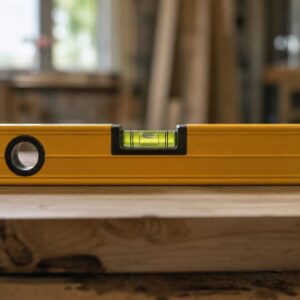
In 1661, a French polymath called Melchisédech Thévenot was fiddling with a curved glass tube, and he noticed something odd. A small bubble of air trapped inside it always drifted to exactly the same spot. Not roughly the same spot. Not close enough. Exactly the same spot, every single time. He had, without quite meaning to, turned a human judgment into a physical law.
That bubble is almost certainly sitting somewhere in your house right now – in a yellow plastic tool bought from a hardware shop for about £4, or a sleek aluminium bar from a better shop for rather more. And it is one of the most quietly revolutionary things in the history of building.
Before the Bubble, "Flat" Was Somebody's Opinion
Before Thévenot's discovery, getting something level was a matter of craft and feel. The experienced builder used a plumb bob, which is a weighted string that gravity pulls perfectly vertical, a water trough, since water finds its own flat surface, which is useful but fiddly, and a great deal of squinting. All these methods worked well enough. The Romans built their aqueducts with them, but there was one big flaw: experience was required to read them correctly. "Level" was something you learned to judge over years of practice, not something you could simply check.
A plumb bob tells you about vertical. A water trough is awkward to carry up a ladder. And the naked eye? Famously, embarrassingly bad at detecting small angles – a shelf tilted by just one degree looks fine until everything rolls off it.
Why a Bubble Always Finds Its Place
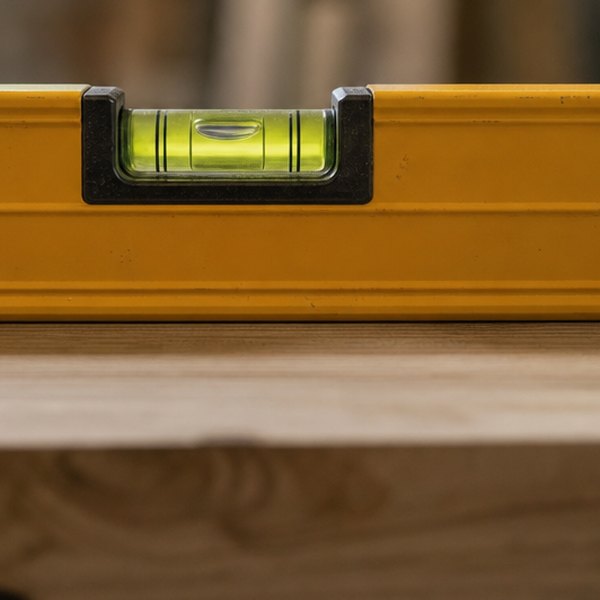
The physics behind the spirit level is genuinely elegant. The tube is filled with a liquid (originally spirits of wine, which is where the "spirit" in spirit level comes from) with just enough space for a small bubble of air. The tube is not straight, it's curved, so the highest point of the curve is in the middle. The air bubble is lighter than the liquid, so it will always float up to the highest point available in the tube. When the tube is perfectly level, the highest point of the curve is in the middle, between the two marked lines, and that's where the bubble will be.
The genius is that you don't need to understand any of this to use one. You just look at where the bubble is.
The Tool That Changed Who Could Build
This is the part that tends to get overlooked. The spirit level did not only make building more accurate. A lifetime of tactile craft knowledge was packed into a small, portable object that could be picked up by anyone. The master craftsman's sense of flat, developed over decades of tiling floors and hanging doors, could now be verified by a complete beginner on a Saturday morning.
That shift matters enormously for DIY as we think of it today, and for the enthusiastic amateur. Such people watch videos of DIY on YouTube, buy tools, and go on to retile bathrooms. The fact that they can measure rather than feel is what their ability to do so depends on. Without calibration tools, you are relying on intuition you haven't developed. With them, you are checking your work against physics, and physics is very patient with beginners.
The most underrated tool in most DIY kits has to be the spirit level. While the drill and sander get all the glamour, it is the spirit level that ensures that what you have done is actually right, rather than nearly right.
For more on what makes a property sound – from what lies beneath the ground to what that means for the building on top of it – take a look at What Your Street Is Standing On (And Why It Matters More Than The Kitchen).
Nearly Right Is Another Way of Saying Wrong
A shelf off by half a degree is annoying. A tiled floor off by half a degree over three metres is a disaster. The errors compound with each tile being slightly more wrong than the last until in the end it looks as if it has been installed by someone who has never seen a right angle.
Thévenot wasn't thinking about bathroom renovation when he sat watching his bubble settle. He was a diplomat, a librarian, a thoroughly curious man who happened to be experimenting with glass tubes. But he handed every future amateur builder something that professional craftsmen had carried only in their hands and eyes for centuries: he put it in a tube, he made it checkable. That tiny floating bubble is, in a very real sense, why you're allowed to have a go.
Questions this raises
- How do you check a spirit level is still accurate?
- Why do cheap spirit levels drift out of true?
- Is a laser level better than a bubble one?
- What did builders use to find level before this?