
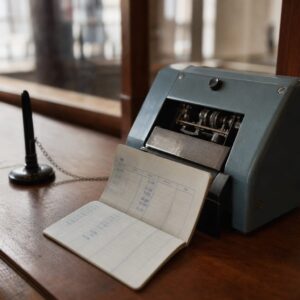
These were high street buildings that were not banks, though they felt like one – wooden counters, hushed atmosphere, the slight sense that you should lower your voice and not ask for anything silly. You brought your passbook and the clerk took it from you, pressed it into the machine and, with a satisfying clunk, handed it back with a new number printed in blue ink. And that is how you saved money. It worked.
The Post Office Savings Bank, the Trustee Savings Banks and the building societies were not accidents of commerce. The Post Office Savings Bank was set up by Gladstone's government in 1861 with a very specific purpose: to get working-class people to put their money somewhere the government could use it. The state would borrow your savings and fund itself. In return, you'd get a safe place to park your wages that wasn't the pub or the floor under the mattress. It was, in the most literal sense, a machine designed to extract money from ordinary people and return it to them later, slightly larger. The whole infrastructure of thrift – the passbooks, the branches, the clerks, the queues – existed for one reason: to make saving feel official, real, and faintly difficult to undo.
The Friction Was the Point
In the 1970s, millions of Britons used these institutions as a matter of course. There were premium bonds (launched 1956, still going), fixed savings accounts and building society shares. The products were not complicated and they have not changed much. What has changed is the ceremony around them.
The saving was done in branches and involved a great deal of ‘friction’ (in behavioural economics ‘friction’ is the small, deliberate obstacles between you and spending your money). The friction of having to go to a branch, of queuing, of handing over a book and waiting for the stamp was so great that by the time it had all been done the saver had already decided that they were a saver. It was almost hard not to be.
What the Disappearance of the Stamp Did to Us
The frictionless savings account — the one that lives in an app, next to the same app that lets you spend money, on the same phone as every online shop you’ve ever opened — is a genuinely modern invention. It’s also slightly strange when you look at it. And, according to pretty much everyone who studies how people actually behave with money, a catastrophe for the saving habit.
It is called the “intention-action gap” by behavioural economists. Most people intend to save. The gap between intending and actually doing it turns out to be almost entirely made of friction — or the absence of it. When saving requires a specific act, a trip, a form, a commitment that feels a bit awkward to reverse, people do it. When saving is just one more option in a menu of infinite frictionless choices, it slides quietly off the to-do list.
The 1970s savers weren't more virtuous than us. They just had less choice about where to put their attention. The building was there. The passbook was in the kitchen drawer. Tuesday was when you went.
The Products Stayed. The Architecture Left.
The products are almost identical. Premium Bonds are still run by National Savings and Investments and the government still borrows money on the same terms that Gladstone invented. ISAs are just the tax-free evolution of what the old savings accounts were doing, and fixed-rate bonds from building societies are almost identical to the savings product that your grandmother had stamped into her book in 1973.
The physical act of saving has gone. That’s what made you feel you’d done something, put something beyond reach, crossed a line. For general money-saving tips and ideas worth reading, The Garden's Busiest Season (You've Probably Already Missed It) is a good place to wander.
What the Stamp Understood That the App Doesn't
The people who set up these institutions may not have been thinking about psychology exactly, but they were onto something. Saving money is not just a mathematical decision – it is a ritual, and rituals need props, places and a bit of inconvenience to stick.
Manufacturing your own friction is the smartest thing to do right now. So set up a separate account that requires three working days to access, and a standing order that moves money the day you're paid, before you see it. And writing down a number by hand counts for something. But none of these are as good as the clunk of a passbook machine, and it's the same idea, and the idea was always right.
FAQ
When was the Post Office Savings Bank set up and why?
The Post Office Savings Bank was established by Gladstone’s government in 1861. Its intention was to enable working-class people to save, by depositing their cash in a fund which the state could then borrow to finance its own expenditure, while providing them with a safe place for their wages as opposed to the pub or under the mattress.
What is the intention-action gap in saving?
The intention-action gap, referred to by behavioural economists, is the space between someone’s intent to save and their actual savings. The majority of people intend to save but are stopped by a number of frictions or, conversely, by the lack of them. Saving that requires a trip or the filling in of a form gets done, but saving that is as frictionless as any other offering is forgotten in the flood of choice.
Why is saving in an app harder than saving with a passbook?
Mobile apps don’t have the same feel of making savings ‘official’ as a branch visit with a queue and stamp. Saving is positioned next to spending on your phone, so it’s easy to dismiss.
How can I add friction to my own saving?
Creating your own level of friction is possible. A separate savings account that takes 3 working days to access money is a good start. Setting up a standing order on the day you get paid to transfer money before you can even view it is another. Writing down the number by hand, even for online banking, has value too. It can help replicate part of the ritual and ‘inconvenience’ of passbook savings.