
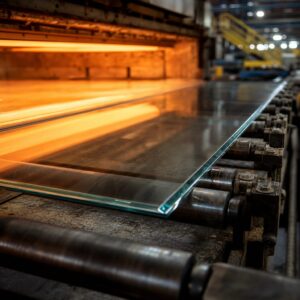
Your window's flat glass looks identical from both sides. Both look transparent and feel faintly cool to touch. One side of the glass was floating on the surface of molten tin at about 1,000°C when it was made. The other side had never been touched by anything except a stream of nitrogen and hydrogen, carefully mixed.
Same glass. Two entirely different chemical histories.
The float glass process that was pioneered by Pilkington in St Helens in the 1950s is still the dominant method for the production of flat glass. In this process molten glass is continuously poured onto a bath of liquid tin. By gravity the glass spreads out into a ribbon of uniform thickness and travels along the bath as it slowly cools. The glass has two main surfaces, the tin face and the air face. The tin face absorbs trace amounts of tin atoms into its surface but the air face absorbs nothing.
The Side That Got Slightly Contaminated
Neither side looks wrong, as the glass leaves the line clear of any apparent tin contamination. However, when viewed under an ultraviolet lamp the tin face will fluoresce faintly, enabling the glazier to correctly identify both faces prior to processing.
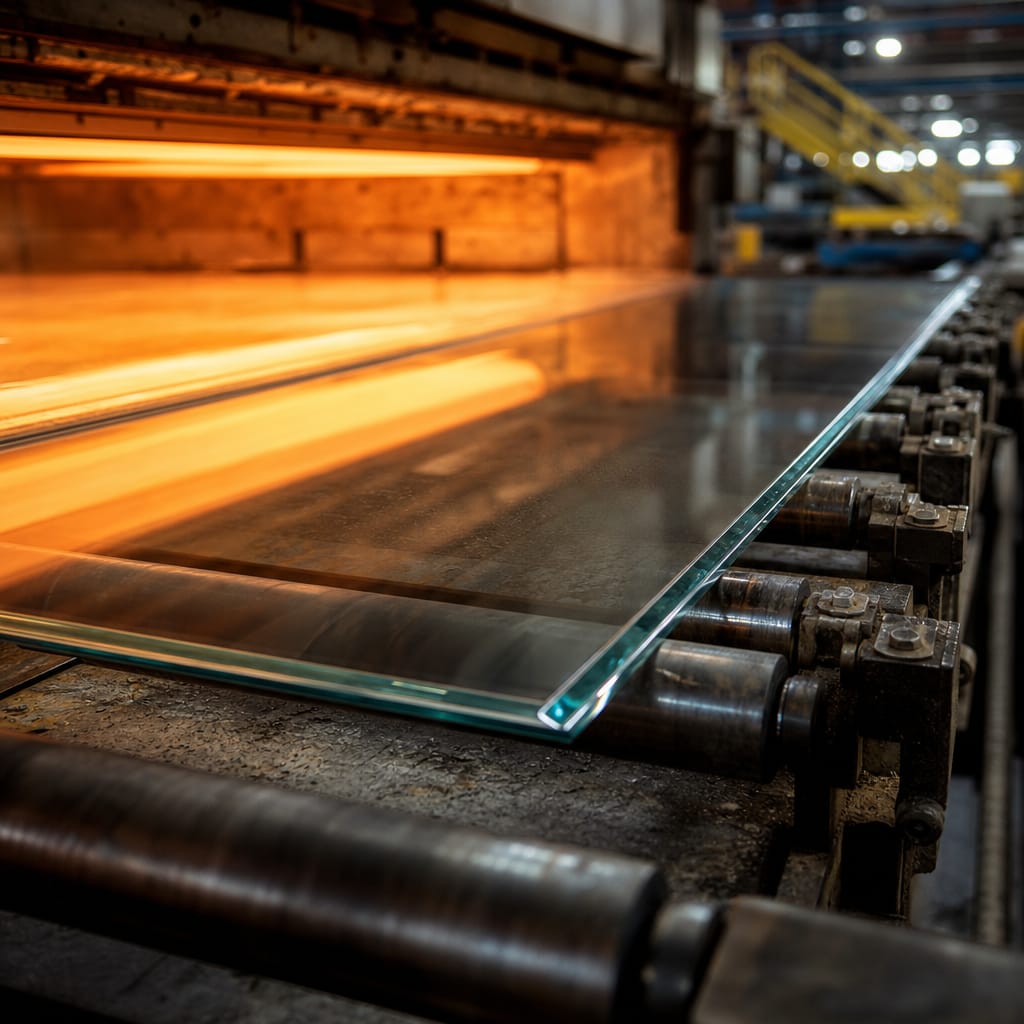
This matters because glass on its own is just glass. The cleverness of modern glazing is in the coatings that keep heat in, reflect solar gain or repel rain and grime. All of these coatings only adhere correctly to the side of the glass that has come through the production process with no contact with the tin. A low-E or solar-control coating, for example, would just sit on the tin surface and not function if it were applied to the tin face of the glass.
Where This Actually Bites You
In a small window a poorly performing coating may cause minor inconvenience. In a large glazed surface such as those created by bifold doors extending along much of a wall, a poorly performing coating can result in a room being hot in August and turning into an accidental conservatory. In such situations more glass means more work for the coating and therefore greater importance on getting the coating to the correct face. For some ideas on how larger glazed areas can be used in a living room, see 5 Living Room Ideas that Put Bifold Doors Front and Centre.
A double-glazed unit consists of four glass surfaces. The coating on each glass surface is specified for one surface only – first surface, second surface, third surface or fourth surface, counted from outside in. The thermal performance of a double-glazed unit can change if these are specified incorrectly.
You cannot check which surface a coating is on by looking at it. The glass has always known which side it is. It just doesn’t tell you.
—
Can you actually check which side is which yourself?
Yes, the UV trick is real and isn't expensive. A basic UV torch (used to check banknotes for example) makes the tin side fluoresce a pale blue-white colour. By holding the UV torch close to the glass in a darkened room, one face will appear to glow slightly more than the other. Bare uncoated glass shows up the difference more clearly.
If a coating ends up on the wrong face, does it look wrong?
It won’t look obviously wrong. A low-E coating on the tin side of the insulating glass unit will have the same faintly metallic colour that most low-E coated glass has. It will look fine in its frame. The failure will be thermal rather than cosmetic. You’ll notice how hot it is in the room in summer long before you notice anything amiss with the glass.
So do all window coatings have to go on the air side?
While many low-E coatings are applied during the manufacturing process, while the glass is still hot, to the tin bath face of the glass (known as hard-coat low-E or pyrolytic coatings), others such as the soft-coat low-E coatings more commonly used in modern double glazing are applied after the glass has been made, on the air side of the glass in a vacuum chamber. These coatings are more thermally efficient than their hard-coat counterparts, but cannot be left exposed to the air and are therefore always found within a sealed unit.
Does the tin side affect how glass cuts and breaks?
A little. The tin face is marginally harder, which is why glaziers have a preference for which side the scoring wheel runs on during cutting. It's not dramatic, but it's enough that getting it the wrong way round makes a clean score slightly harder to guarantee.
FAQ
How can you tell which side of a window is the tin side?
Use a basic UV torch, the sort used to check banknotes, in a darkened room. The tin side fluoresces a pale blue-white and appears to glow slightly more than the other face. Bare, uncoated glass shows the difference most clearly, so the check is easiest on glass without a coating.
What is the float glass process?
The float glass process makes flat glass by pouring molten glass continuously onto a bath of liquid tin. Gravity spreads it into a ribbon of uniform thickness that cools as it travels along the bath. Pilkington pioneered it in St Helens in the 1950s, and it remains the dominant method.
What happens if a low-E coating is on the wrong side of the glass?
It will not look wrong, but it will not perform. A low-E coating on the tin side has the same faintly metallic colour as any other and simply sits there without functioning. The failure is thermal, so a room can get hot in summer, especially with large glazed areas such as bifold doors.
Do all window coatings go on the air side of the glass?
No. Hard-coat (pyrolytic) low-E coatings are applied during manufacture while the glass is still hot, on the tin bath face. Soft-coat low-E coatings, more common in modern double glazing, are applied afterwards to the air side in a vacuum chamber. They are more thermally efficient but must sit inside a sealed unit.