
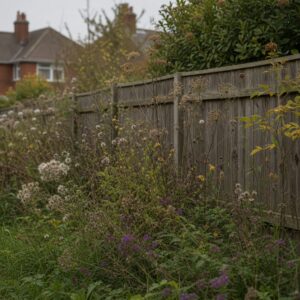
A still October morning and you stand at the bottom of your garden to look at what's growing along the fence line. These are not just your own gardening history but that of your neighbours, their neighbours and whoever lived three doors down in 2003 and thought a bamboo screen would look smart.
The fence is largely decorative as far as plants are concerned.
The Conveyor Belt Nobody Ordered
The prevailing wind in British suburban streets is something you probably know in the way you know your bin day – vaguely, and only when it matters. But plants have known it forever. A steady south-westerly (and it's south-westerly on most streets in England and Wales) acts as a one-way postal service, dispersing seeds from ungardened plots and depositing them along the fence lines of everyone downwind.
Dandelion clocks, thistle fluff, herb robert and hairy bittercress are all sorted and distributed by this wind, consistently, every autumn. The weeds in your borders are partly a map of your street, weighted by distance and direction.
If you've ever wondered why one side of your garden is permanently fighting something the other side never sees, that's usually why.
The Neighbour Who Doesn't Deadhead
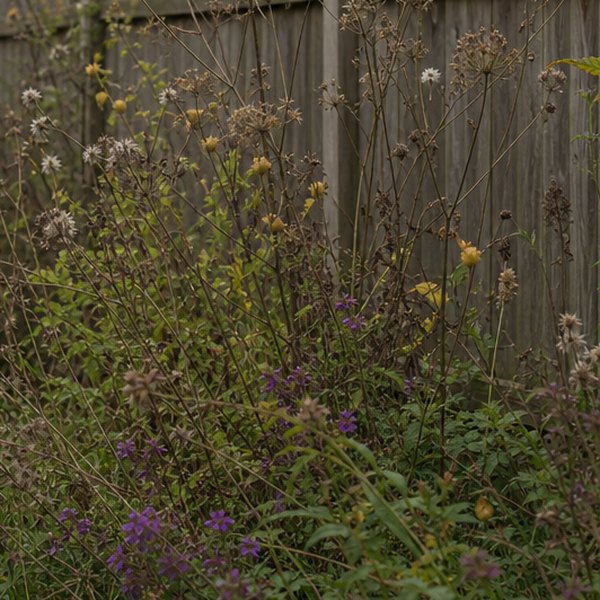
It takes just one plant left to set seed to produce thousands of viable seeds in one season. A poppy, for example, can produce up to 17,000 seeds from a single seedhead before the frosts arrive. One neighbour who doesn't deadhead their verbena, fennel, foxgloves and Welsh poppies becomes an involuntary donor to the street's collective seed bank. Which sounds quite romantic until it's your border.
The soil is part of this too. Spores of soil fungi spread through the roots of plants and through the air. The mycorrhizal networks that help plants share water and nutrients with each other don't stop at boundaries; they thread through the ground beneath fences like an underground conversation happening without anyone's permission. What's living in your soil is partly a function of what's living in your neighbour's.
The One That Travels in One Direction Only
Japanese knotweed is the starkest version of this. It spreads in fragments of root, all spreading without the need for seeds and at about a metre a year, more in good conditions. Along a Victorian terrace where gardens back directly onto each other with no gap, it can spread through a row of houses. By the time it appears in your garden it may have originated several plots away, years ago. For advice on what happens when knotweed crosses a property boundary and becomes a legal matter, The Words You Sign Your Life Away With is worth a read.
Knotweed is the dramatic case, but ordinary bramble does the same thing at a more sociable pace. Tree roots don't respect boundaries either – a silver birch planted close to a fence by your neighbour will be drinking from your soil within a decade.
What Your Garden Is Actually a Portrait Of
Now you know this, you can start to read your garden differently. That patch of Himalayan balsam on the back of your fence almost certainly didn't start with you. As a waterside plant it follows drainage channels and damp ground through connected gardens. Herb robert arrived on the wind from somewhere, stuck, and now self-seeds quietly in perpetuity, appearing every year in the same corner of your garden. The thick clay in one patch might reflect decades of foot traffic from a previous garden use next door.
This is levelling. What you’re doing in your garden is a private project, shaped purely by your own choices. But what you’re actually doing is tending a small section of a much larger, ungoverned ecosystem that happens to have a fence running through it. Your neighbours’ neglect, their enthusiasms, their choice of trees twenty years ago – all of it has left a deposit in your soil.
What you are doing in your garden does migrate outward – just as everyone else’s does. The bees from your lavender visit six other gardens. And the hedgehog sheltering under your shed probably sleeps in three different gardens across the week.
The fence was never really the boundary. It just marks where you stop mowing.
Questions this raises
- Which garden plants spread furthest on the wind?
- How do you stop seeds blowing in from next door?
- Can you make a neighbour cut back an invasive plant?
- Why is the prevailing wind south-westerly across most of Britain?