
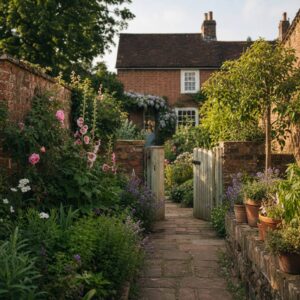
Somewhere in Britain right now, someone is arranging terracotta pots on a patio and feeling faintly smug about it. Fair enough. But that patio, those pots, the whole idea of treating your back garden as an outdoor room for your own pleasure – it's a remarkably new thing, and it got here through a stranger route than you'd think.
For most of human history, if you were wealthy enough to have land, your garden was about power, not petunias. The great formal gardens of the seventeenth century – vast, geometrically brutal, trimmed within an inch of their lives – weren't for relaxing in. They were for demonstrating that you controlled nature itself, which was a useful signal when you also controlled several thousand acres and a lot of frightened tenants. Capability Brown's sweeping parklands in the eighteenth century were the same idea at even greater scale: landscape as theatre, not garden as garden. The point was never the feel of the soil. It was the view from the house.
Plots for the Working Man's Soul
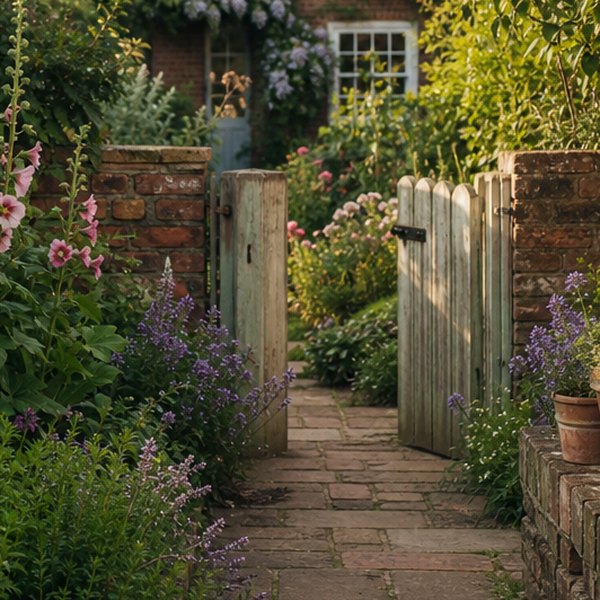
The cottage garden – all tumbling roses and hollyhocks and bees in lavender – feels ancient. It isn't. What actually happened is that Victorian industrialists and social reformers looked at the gin shops filling up with newly urbanised factory workers and got worried. So they came up with the allotment and the small garden plot, promoted with enormous Victorian confidence: give a man a bit of earth to cultivate, and he'll spend his evenings digging instead of drinking. Morality delivered in the form of soil.
Working-class garden culture, in other words, was deliberately engineered as an alternative to vice. The cottage garden mythology – the idea that this was somehow timeless rural England preserved intact – was largely invented afterwards, romanticised by people like Gertrude Jekyll, who was upper-middle-class and writing for an audience that could afford a gardener to do the actual work.
The Semi-Detached Gets a Back Garden
The twentieth century is where it gets interesting for most of us. The great suburban expansion of the 1930s put a garden behind virtually every new house, and suddenly millions of people had a private patch of ground with nobody telling them what to grow. This was genuinely new. Not an allotment with rules, not a landlord's estate, but yours. The response was very British: lawns, mostly. They were manageable, they looked respectable from next door, and they needed relatively little knowledge to maintain.
Post-war, the garden shed arrived as its own institution, and the vegetable patch made a comeback during rationing and never quite left. But all of this was still, fundamentally, productive or presentable. The idea of sitting outside for pleasure – a sun lounger, a glass of something cold, a table for eating – came later. Largely through the influence of continental holidays. British people went to Tuscany, came back slightly changed, and started looking at their garden differently.
The Room That Used to Be Outside
The bifold door is probably the most honest symbol of where we've ended up. When a wall folds away and the living room and the garden become one continuous space, the garden stops being a garden in the old sense and becomes a room that happens to be outside – with furniture chosen for it, lighting strung across it, a kitchen sometimes built into it. If that's the direction your own place is heading, 5 Living Room Ideas that Put Bifold Doors Front and Centre is worth a look.
This would have been genuinely incomprehensible to a factory worker in 1860 digging his allotment plot under instructions from a philanthropic mill owner. Or, for that matter, to a 1930s suburbanite keeping his lawn edged for the neighbours' benefit. The idea of the garden as an extension of your leisure, your personality, your living space – it's maybe sixty years old at most.
What You're Actually Doing When You Garden
Which perhaps explains why gardening generates such strong feeling. Every generation thinks it's just pottering about, expressing a natural human instinct for growing things. But what's really happening is subtly different each time: survival, morality, respectability, aspiration, pleasure, self-expression. The tools look the same. The impulse behind them keeps quietly shifting.
Your terracotta pots are a very recent freedom. Enjoy them.
Questions this raises
- When did ordinary British households start gardening for pleasure?
- Why were formal gardens designed to look so controlled?
- How did back gardens turn into outdoor rooms?
- Did allotments come out of the same shift?