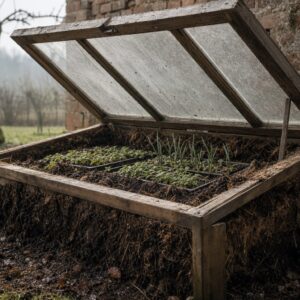
Under those impossibly early cucumbers there was a pile of horse manure. Manure for the Victorian country house table in February, when the outside fields were iron-hard and grey. Not just metaphorically, gently steaming and rotting with purpose. For the roots of these things that had absolutely no business being alive in February to be kept at a precise and steady warmth, the manure below did all the actual work, while the glass above gets all the credit in the history books.
The Hotbed (Your Plug-In Propagator's Smellier Ancestor)
A hotbed was a deep pit or low frame packed with a lot of fresh horse manure — and the word ‘fresh’ is doing heavy lifting there. Manure that had already composted was useless for this. It had to be still actively fermenting, still alive with microbial heat. Typically a hotbed was a foot to eighteen inches deep, sometimes more for winter work, and then a layer of loam or compost on top of that. Seeds or cuttings were put into the loam and the whole thing sat under a glass light, essentially a wooden-framed pane, to hold the warmth in.
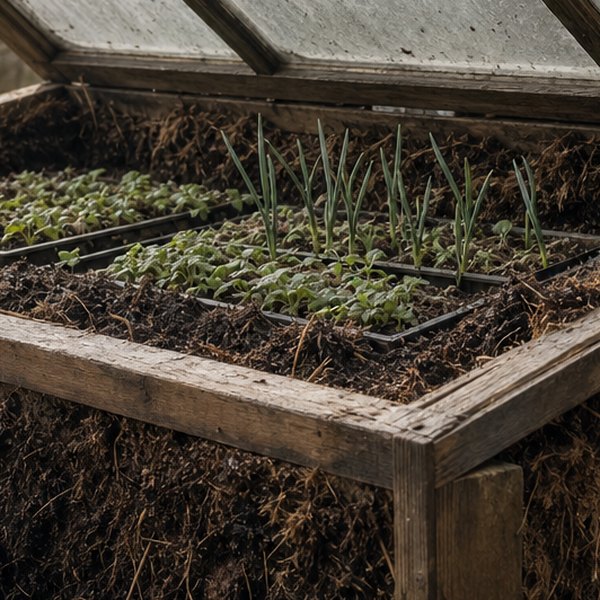
What you ended up with was a self-heating growing chamber that needed no electricity, no thermostat, and no engineer. What it did need was a head gardener who understood exactly what was happening inside it.
Reading the Rot
This is the part that gets genuinely interesting. A fresh hotbed can spike up to 70°C or more in the first few days and so kill everything you'd just planted. You have to wait, monitoring the temperature each day with a long-stemmed thermometer pushed into the bed, and let the initial fever break. The working temperature for most crops is between 18°C and 24°C. If it is too cool then germination stalls, but if it is too hot then you'd cook the roots.
Over time, the fermentation slowed and the heat dropped. A skilled gardener could more or less judge how much life was left in a bed by feeling it – lifting a corner, noticing the change in smell, and watching the condensation on the glass. As it started to fade, you’d pack fresh manure around the outside of the frame to give it another burst. This was called ‘linings’ and was less like operating equipment and more like tending something.
The Victorians were managing biochemistry with their hands. They just didn't call it that.
What You Could Actually Grow
The hotbed was behind the Victorian kitchen garden's reputation for near-miraculous produce. Cucumbers in February, melons through the summer that had no real business ripening in England, and tomatoes long before anyone outside had thought about putting theirs in. Early lettuces and radishes for the house through the grey months.
For the grand estates it was partly about showing off – the ability to serve your guests a cucumber in winter was a display of horticultural mastery that impressed people who understood exactly how difficult it was. But for smaller kitchen gardens it was more practical: extending the growing season at either end meant fresher food for longer. If you’re weighing up older rural properties with walled gardens that aren’t quite what they once were, then What You Buy When You Buy a House (It's Not What You Think) is worth a read for buying tips on property with kitchen garden potential.
What Happened When the Horses Left
In time, the motor car would prove more destructive to the hotbed than any harsh winter. Fresh horse manure was no longer easy to source, then became expensive, and finally had to be specifically sought out rather than simply arriving at the stable yard every morning. Electric propagators appeared and performed the temperature-control work without any smell and without daily monitoring. Gradually, knowledge of how to build and manage a hotbed stopped being passed on.
It's a shame, because the underlying principle hasn't gone anywhere. Fresh horse manure still generates exactly the same heat through exactly the same fermentation process. So if you keep chickens or horses, or if you live near a stable and ask nicely, you can build a rudimentary hotbed in spring – a heap of fresh manure, a sheet of glass, even a cold frame and a thermometer. This way you can still extend the season for no cost and without any electricity.
It just requires learning to read the rot. Which turns out to be a rather satisfying skill.
Questions this raises
- How hot does a fresh manure hotbed actually get?
- Can you still build a hotbed in a modern garden?
- Why must the manure be fresh rather than composted?
- What did Victorian gardeners grow out of season?