
Nobody plans their best DIY thinking for three in the morning. And yet there you are, lying in the dark, one ear cocked toward a dripping sound you've decided to interpret as either "nothing" or "catastrophic", furiously Googling on your phone while trying not to wake anyone up. This, weirdly, is when most people do their deepest thinking about how their house actually works.
The daytime version of DIY is practical. You've got a tape measure, a YouTube tutorial, good light. But the 3am version strips all of that away. What you're left with is one blunt question: is this thing safe to leave until morning? And underneath that, almost always, is a more honest one: how does this thing work?

Most of us don't know. Not really.
The Plumbing Question You're Asking
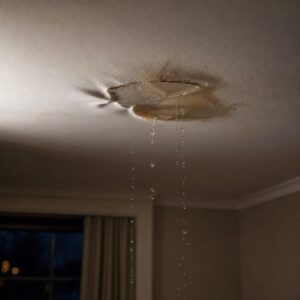
The most Googled version of this is some variation of "water coming through ceiling safe to leave". And the reason it's so common is that most people can't answer it themselves – not because they're hopeless, but because they don't know what's above that ceiling. Is it a pipe? A tank? A radiator joint? The answer changes everything.
What's worth understanding before you're ever in that position is this: your home's plumbing is two separate systems that look the same from the outside. There's the mains-fed supply (cold water, under constant pressure, always live) and the gravity-fed system from a header tank usually in the loft (lower pressure, can be stemmed by cutting off the tank's supply). A burst from the first is urgent. A weeping joint from the second might genuinely be fine until morning – IF you know which one it is and you can slow it down.
Finding your stopcock before you need it is obvious advice. Less obvious: find the loft tank valve too. It's usually a simple ballcock arm you can tie up or block, and knowing that exists changes your 3am options completely.
The Electrical One (Which Is Two Questions)
"Is it safe to leave a tripped fuse overnight?" That's the question. But there are really two things being asked underneath: did the circuit trip because of a fault, or because of a surge? A modern consumer unit with RCD protection trips for both and gives you almost no information about which one happened.
The practical truth is this – if a circuit trips, something caused it. If it trips again immediately when you reset it, do not keep resetting it. That's a fault, and faults generate heat. If it stays on, you're probably dealing with a surge or an overloaded socket, and yes, it can usually wait. The difference matters enormously at 3am, and it takes about ten seconds to find out which you're dealing with.
What most people don't know is that a UK consumer unit built after 2008 almost certainly has split RCD protection, meaning only half your circuits go down at once. If your whole house goes dark, it's the main switch or a power cut, not a tripped breaker. Half the house going dark is almost certainly an RCD. Understanding the layout of your own board – which ring main covers which rooms – is one of those ten-minute jobs that pays off entirely in the dark.
The Noise That Gets Interpreted Wrong
Pipes ticking and creaking as they heat up and cool down is normal, and most people know that. What fewer people know is that a persistent knocking from inside a wall (not from outside, from inside) is often water hammer – the shockwave that travels through pressurised pipes when a valve closes too fast. It sounds alarming. It isn't an emergency. But it is a sign of high water pressure or failing pipe clips, and if it's been going on for months, it's slowly fatiguing your joints.
This is the kind of thing a daytime project can sort – checking and adjusting your pressure, re-clipping pipes in accessible runs. For rethinking how your rooms are set up to accommodate a workspace, there's some useful thinking over at How to create a WFH office without losing a bedroom.
The Real Point of All This
The 3am Googler isn't panicking irrationally. They're doing something quite sensible – trying to understand a system they've inherited without a manual. Most houses come with no explanation of themselves at all. The boiler, the consumer unit, the stopcock, the header tank: four things that run your entire home, and most people couldn't locate all of them in the light, let alone the dark.
An hour spent finding them and understanding what they do is, genuinely, the most useful DIY you can do. No tools required.
Questions this raises
- What causes a dripping sound with no visible leak?
- Is a gurgling pipe at night worth worrying about?
- When should you turn the water off until morning?
- How do you find your stopcock in a hurry?