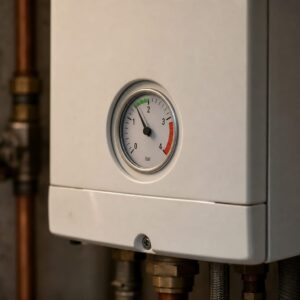
There is a small dial on the front of your boiler – probably behind a panel you've never opened – and it almost certainly reads somewhere between 1 and 2. Maybe there's a green zone, a red zone, a needle sitting somewhere in the middle looking faintly pleased with itself. The number is probably 1.5. You've almost certainly glanced at it, thought "that seems fine", and gone to make a cup of tea.
What you haven't thought about is where that number came from. It didn't come from a heating engineer sitting in a warm office deciding what temperature your living room should be on a Tuesday in February. It came from the railways. And before that, from a very long history of boilers killing people.
The Atmosphere, Pressed Into a Number
One bar is, roughly speaking, the weight of the Earth's atmosphere pressing down on every square centimetre of surface at sea level. The "bar" unit was formalised in the early 20th century, but the concept it measures – atmospheric pressure as a reference point – goes back to the mid-1600s, when Evangelista Torricelli first demonstrated that air had weight and that weight could be expressed as a column of mercury. The word "bar" itself comes from the Greek "baros", meaning weight.
So when your boiler gauge reads 1.5 bar, it means the water inside your heating system is under one-and-a-half times the pressure of the entire atmosphere sitting on top of you right now. Which is, when you think about it, a slightly dramatic way to describe the thing warming your kitchen.
The Problem With Industrial Boilers (They Kept Exploding)
Steam power in the 19th century was extraordinary and frequently lethal. Factory boilers, locomotive engines and steamships ran at pressures that, if the vessel cracked or a valve seized, would detonate the whole thing with the force of a small bomb. Boiler explosions were common enough in Victorian Britain that Parliament eventually got involved. The Boiler Explosions Act of 1882 mandated formal investigation of boiler accidents, and the engineering profession developed increasingly precise standards for how much pressure different materials could safely contain.
This is where the pressure measurement tradition your boiler is running on was actually built. Every standard, every safety margin, every gauge reading was calibrated against one question: at what point does this vessel fail catastrophically? The unit and the culture around monitoring it were forged entirely around industrial prevention of disaster, not domestic comfort. The little needle on your boiler is the direct descendant of instruments designed to stop a locomotive from turning a railway platform into a crater.
For plumbing and heating advice that makes more sense of all this, What the Pub Landlord Knows That You Don't.
How a Locomotive Measurement Ended Up Warming Your Radiators
Central heating as we know it in British homes – sealed pressurised systems with a boiler, pump and radiators – was largely a post-war arrival. By which point the engineering and measurement standards for pressurised water systems were already thoroughly baked in. The industry inherited them wholesale. Nobody sat down in 1965 and decided that bar was the ideal unit for a three-bedroom semi in Coventry. It was just what engineers already used, the instruments already read it, and there was no compelling reason to invent something new.
So domestic heating got a measurement system designed around the question "how do we stop this from exploding?" rather than "how do we keep a house comfortable?" The safe operating range for a typical combi boiler – roughly 1 to 1.5 bar when cold, rising to perhaps 2 bar when the system is hot – isn't arbitrary. It's a pressure window derived from understanding what sealed systems can tolerate, just scaled down enormously from the working pressures of an industrial boiler running at 10, 15, even 20 bar.
What 1.5 Bar Is Actually Telling You
When your gauge drops below 1 bar, the system has lost water. Probably through a slow leak somewhere or via the pressure relief valve. Your boiler will likely lock out to protect itself. Creep above 2.5 or 3 bar and the pressure relief valve opens and dumps water out, which is the system doing exactly what a Victorian safety engineer designed it to do: releasing before something gives way.
Repressurise too low, the pump struggles to push water around the circuit. Too high, and the expansion vessel – a small chamber that accommodates water expanding as it heats – can't do its job. So the needle really does matter, even if the unit it's measured in was never designed with your radiators in mind. It's just reading from a very old checklist, one that was written when getting it wrong had considerably more dramatic consequences than a cold bathroom.
FAQ
What should my boiler pressure be?
For a typical combi boiler the cold system pressure would be around 1-1.5bar. This may rise when the boiler is in full heat mode up to 2bar. This range is what a sealed system can operate safely at, greatly reduced from industrial boilers that can run at 10, 15 or even 20bar.
What does it mean if my boiler pressure drops below 1 bar?
When the system pressure is below 1 bar, a boiler will typically lock out to protect itself, as the system has lost water (either via a slow leak or by the pressure relief valve acting). The system will struggle to operate when running at very low pressures as the pump will find it difficult to circulate water throughout the system.
What happens if boiler pressure gets too high?
When the pressure increases above 2.5 or 3 bar, the pressure relief valve opens and the water is released. In this case, the safety concept has functioned as intended in order to prevent damage. In addition, high pressure prevents the expansion vessel from functioning properly. The expansion vessel is a small container which compensates for the water expanding as it heats.
Why is boiler pressure measured in bar?
The pressure of a boiler is expressed in bar, a unit inherited from industrial and railway engineering, notably for steam boilers which were known to explode. As sealed home heating systems arrived after the war, the existing safety standards were simply kept. The bar was formalised in the early 20th century, but as a concept it dates to the mid-1600s.