

It's a very specific smell. You know the one. You will have met it before, wrestling a flat-pack wardrobe up the stairs, incorrectly following the instructions, following them again, until the thing is standing upright and breathing into your bedroom. The smell is sweet, slightly chemical, vaguely sawdust-y. New furniture smell. For half the country, it is deeply satisfying – the smell of progress, of a room finally coming together. For the other half, it is quietly unsettling, and if you ask them why, they probably can't tell you. They just open a window.
This divide traces back to a specific moment: a 1996 BBC Watchdog investigation into flat-pack furniture, which said, politely but firmly, that some of it was gassing formaldehyde into British living rooms. Not in catastrophic quantities, but enough to be there, measurable, drifting out of the compressed wood and adhesives that hold budget furniture together. Enough to stick in the national consciousness.
What the Smell Actually Is
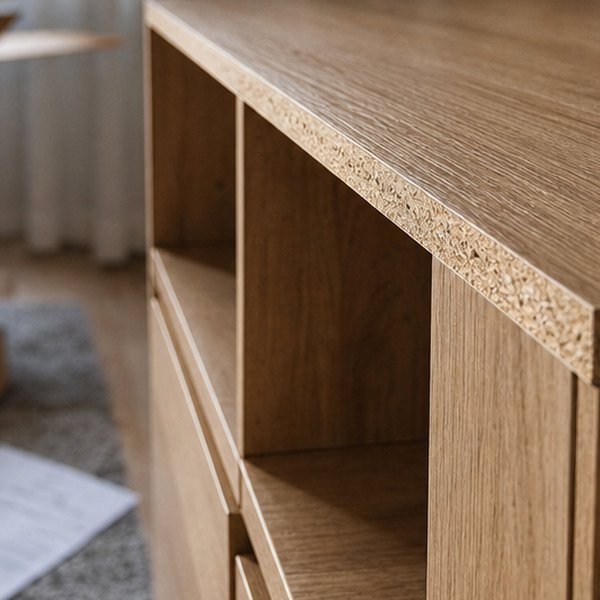
That distinctive new-furniture smell isn't wood. Real wood has its own smell – warm and resinous – and it mostly stays put. Most flat-pack and MDF furniture gives off a slow chemical exhale: volatile organic compounds (VOCs) evaporating out of the resins and adhesives used to bind the material together. The main culprit in pressed-wood furniture has historically been urea-formaldehyde resin, which keeps particleboard and MDF stable and cheap to manufacture. This continues releasing low levels of formaldehyde gas for months or years after the thing is built.
Formaldehyde occurs naturally in trace amounts in the air, in fruit, and in the human body. The argument with flat-pack furniture has never been that it is poisonous in the same way as a cleaning product. In small, poorly ventilated rooms with several pieces of new furniture, levels can accumulate to a point where your eyes water and your throat feels odd. Which, it turns out, some people had already noticed and quietly attributed to coincidence.
The Watchdog Moment
The 1996 investigation did not produce a product recall or a national scandal. What it produced was something more durable: a background awareness. The kind that is passed from parent to child at the point of furniture assembly. “Open the windows, let it air out.” That awareness was absorbed by a generation of British buyers who, not quite knowing why, carried it forward into a habit of airing new furniture before sleeping near it, of feeling vaguely suspicious of that sweet chemical smell rather than delighted by it.
Manufacturers weren't ignoring the problem. Through the late 1990s and 2000s, the industry moved steadily toward lower-emission resins and stricter production standards. The European emissions classification system that now appears on furniture labels – E1 and E2 ratings, measuring formaldehyde release per cubic metre of air – was already being tightened, with the E1 rating being the standard you want, allowing no more than 0.1 parts per million of formaldehyde release. Better-grade furniture now often advertises compliance with even stricter CARB2 standards (originally Californian, broadly adopted internationally). The label is not decoration, it is the furniture industry quietly accounting for the anxiety that the Watchdog generation carried into every IKEA car park.
For buying advice that covers what actually transfers with a property – including fixtures, fittings and everything in between – What You Buy When You Buy a House (It's Not What You Think).
Why It Still Shapes British Interiors Now
For those who think about how rooms look and feel, here is where it gets interesting. The residual suspicion of cheap pressed-wood furniture — not fear exactly, more a low-level wariness — pushed a portion of British buyers upmarket in ways they don't always consciously explain. Solid wood costs more, but it doesn't have the same off-gassing profile. Secondhand furniture, having been aired out over years, has none of it. The market for vintage and secondhand furniture boomed through the 2000s and 2010s with plenty of drivers, but one of them, buried and rarely stated, was this instinct: that old furniture had already finished whatever it needed to do chemically.
So there’s a split in British interior aesthetics that has almost nothing to do with taste and almost everything to do with one television programme from 1996. Some rooms are built around the smell of newness, others around the quiet comfort of things that have already aired out. Both can look lovely, but one of them will make you open the window.
Questions this raises
- What is the smell coming off new flat-pack furniture?
- How long does new furniture take to stop off-gassing?
- Are formaldehyde limits on British furniture tighter now?
- Should you air a new wardrobe before filling it?