
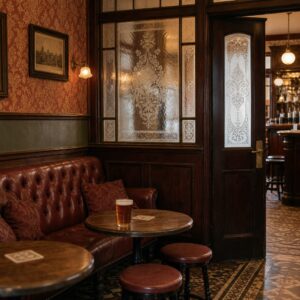
If you walk into almost any British living room that was put together without much conscious effort – the kind where the owner will say "oh, we just kind of accumulated things" – you'll find a dado rail, or a deep-buttoned sofa pushed against the wall, or a patterned rug anchoring the seating, or frosted glass in the door to the hall. Sometimes all four. The received wisdom is that these things come from Georgian townhouses, from country estates filtered down through magazines, from some innate island taste for cosiness and symmetry. But there is a more likely culprit, one that has been hiding in plain sight on every high street in Britain for about a hundred and fifty years. Your living room looks the way it does because your great-great-grandparents spent their Saturday evenings in the pub.
The Victorian Pub As Showroom
The great Victorian and Edwardian pub refits were, in their way, extraordinary acts of interior design democracy. In their aggressive competition for drinkers, the brewery companies chose grandeur as their weapon. Mahogany bar fittings, patterned encaustic floor tiles, etched and frosted glass screens, fixed upholstered seating along the walls and dado rails separating rich wallpaper from painted plaster below all poured in to make the snug and the lounge bar – essentially the first designed interiors that ordinary working people could walk into, sit down in, touch, and spend real time inside.
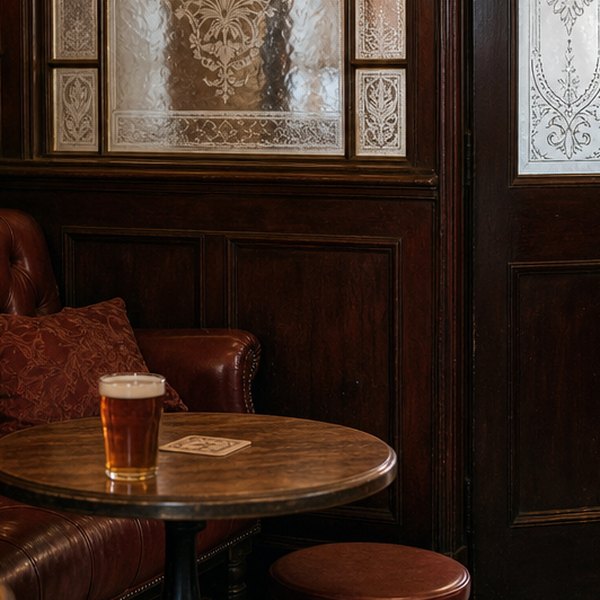
You might see a Georgian drawing room or an Edwardian merchant's parlour through a window if you were lucky, but the pub you could inhabit for three hours on a Friday night, running your fingers along the brass rail, sitting on the buttoned leather and feeling the warmth of a properly considered room doing what it was supposed to do: making you feel, for the price of a pint, like someone worth designing a room for.
The Long Migration Home
The features of these evenings did not stay in the pub. They came home in people's heads. Not in a deliberate, copying sense. No one sat in the snug with a notepad. But the settled feeling of what a proper room was supposed to contain was absorbed. The dado rail existed because rooms in pubs had dado rails. Upholstered seating pushed to the wall worked because you could see at a glance that it worked. The patterned tile in the hallway, the etched glass panel, the warm, dark paint below the rail and something lighter above – all of these features were absorbed as instinct, as the visual grammar of a comfortable interior. They were then replicated across generations of terraced houses and semis, without anyone necessarily knowing why.
This is a pub layout, not a drawing room. Pub seating is arranged at the edges of a space, with a middle area left clear, everything oriented inward toward warmth. In a drawing room the furniture is arranged to facilitate conversation, facing inwards. But in a pub the seating is arranged so that everyone can sit together without quite having to commit to sitting together. Which, if you think about it, describes the average British living room almost perfectly.
For more on how the living room's back wall has become a design choice in its own right, see 5 Living Room Ideas that Put Bifold Doors Front and Centre at perkypad.co.uk.
The Spell and What Broke It
The borrowed pub interior worked so well for so long and it was partly because it was so well suited to the terraced house. The modest rooms benefited from the same tricks of division and upholstery that made a Victorian bar feel larger and more distinguished than it technically was. The lower parts of the walls were dark, which made the floor feel grounded. The fixed seating against the walls of small rooms stopped them from feeling cluttered and the patterned floors of the bare boards held the eye and made them look intentional.
What eventually broke the spell was light, or rather the ambition to have more of it. The bifold door that folds back an entire wall of the living room to join it to the garden is as far from a Victorian snug as you can get. It does not cocoon, it opens. It does not create intimacy with division and enclosure, it removes the wall entirely and lets the outside become part of the room.
What You Are Left With
Both impulses are running through British homes at the same time. There’s the continued dado rail in the hall and the buttoned sofa in the corner. There’s also the back wall of glass that folds away to reveal a patio. The pub and the garden, side by side. No one planned it, it’s just what happens when instinct meets aspiration. A hundred and fifty years of Saturday evenings is a surprisingly hard habit to shake.
Questions this raises
- Why did Victorian pubs use dado rails and frosted glass?
- What height should a dado rail sit at?
- Do deep-buttoned sofas suit small modern rooms?
- How did pub interiors reach ordinary British homes?