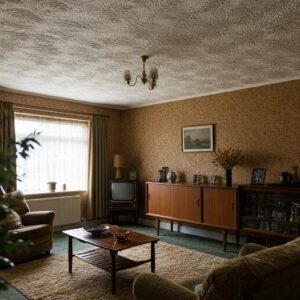
Walk into a 1970s front room and you are inside a very specific smell and a very specific lie. The swirling Artex on the ceiling, the woodchip on the walls, the panelled teak of the sideboard: none of it was there for texture. It was there to cover something up. Underneath, the walls were a catastrophe.
Britain in the 1970s was still living inside its own wartime aftermath. Bomb damage had been patched rather than properly repaired through the fifties and sixties. The Victorian terraces, which had never been insulated, were damp from the inside out. Post-war council builds were ageing faster than anyone had planned for. It wasn't a pretty housing stock. And so an entire domestic industry quietly rose up to solve the problem the only way that was affordable: cover it all up.
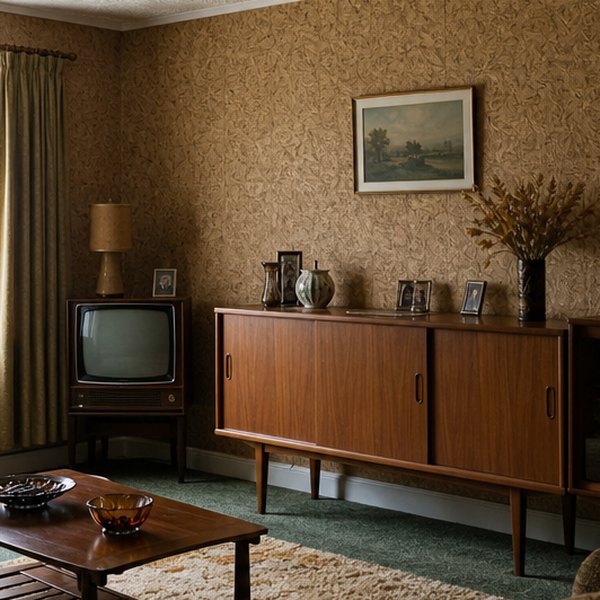
Artex: The Ceiling's Great Alibi
Artex was not a style statement. It was a compound – a gypsum-based textured coating – applied to ceilings that were cracked, sagging, or so uneven that no amount of paint was going to rescue them. You mixed it, slopped it on, and then went at it with a brush, a comb or a sponge. The resulting swirl or stipple pattern was, crucially, impossible to compare against anything flat. You couldn't see the cracks because there was nothing smooth to contrast them with. Genius, really, in a grim kind of way. The pattern wasn't decoration so much as visual noise designed to make the eye give up.
Textured coatings like this could also contain asbestos. HSE advises that buildings built or refurbished before 2000 may contain it, Artex-type coatings included, so have an old ceiling tested before you sand or scrape it.
Woodchip: Paper That Worked Like Armour
Woodchip wallpaper, that beige, lumpy stuff which in the 1990s was steamed off every wall in the land, existed for almost exactly the same reason. It was thick, it was tough, and it covered plaster that had blown off the wall, replastered patches that never quite matched, and those mysterious dark stains that appeared every winter and disappeared every spring. Anaglypta, the embossed white paper with raised patterns pressed into it, served the same purpose on a slightly grander budget. It gave walls the appearance of structure and solidity when what sat behind it was anything but.
Both papers were designed to be painted over, repeatedly. They weren't the final statement; they were the base layer under however many coats of magnolia gloss you could afford.
Anaglypta Started Out as a Victorian Shortcut
Anaglypta was not a 1970s invention and dates from the 1880s. Raised patterns were pressed into thick pulpy paper by Victorian manufacturers. Their intention was to produce a surface which mimicked the appearance of moulded plasterwork, thus avoiding the expense of a plasterer, for the walls and/or ceiling of the front room of a working class family’s new terrace. It was meant to look smart before it was used to conceal the ravages of war.
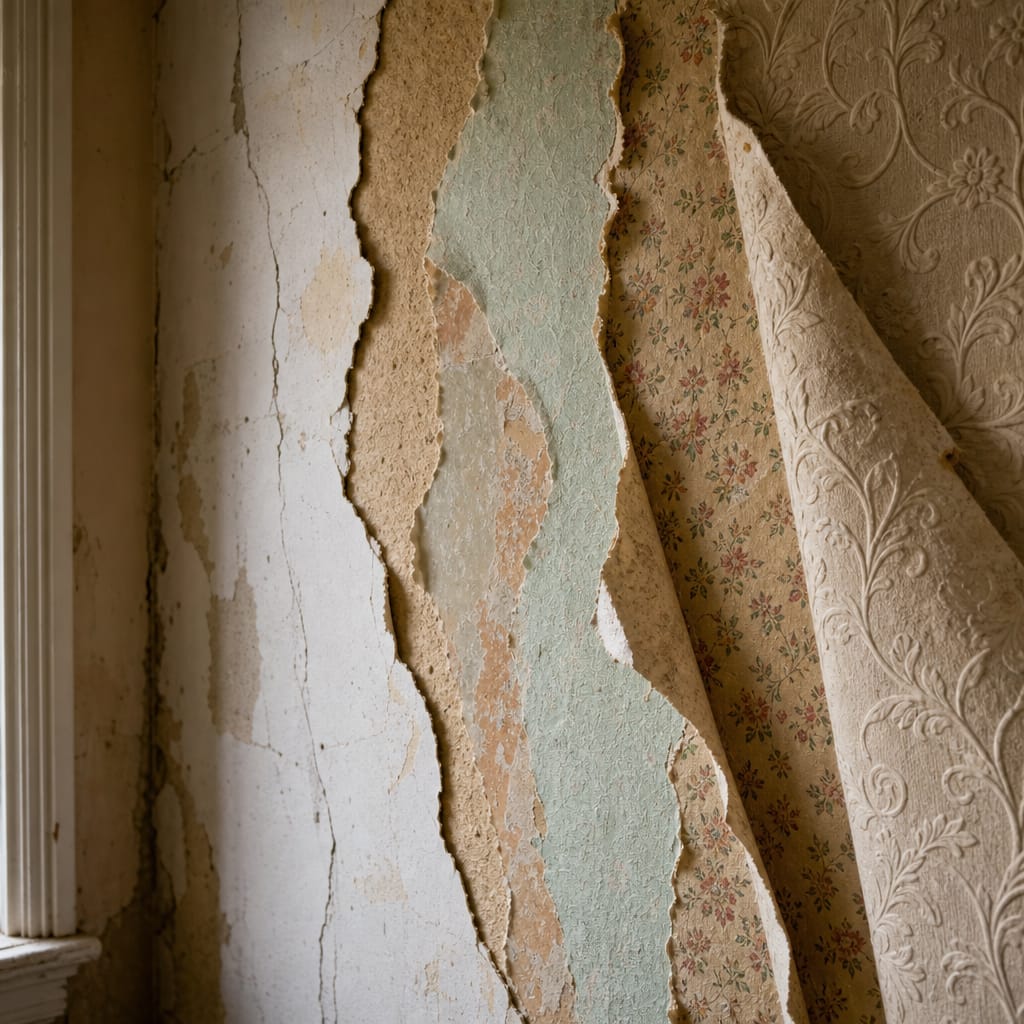
That is why so many older houses have it on their ceilings too, often under several layers of paint. If you strip the walls of an old terrace house you can often see the layers of embossed paper, patterned paper, woodchip and paint, each applied on top of the previous one instead of replacing it.
Teak Veneer: The Surface Standing In For The Solid Thing
Furniture followed the same logic. Teak veneer sideboards, wall units and coffee tables were everywhere as teak became fashionable, but mainly because veneer was cheap. The veneer was a thin slice of actual wood bonded onto chipboard or MDF, which meant you could suggest solidity without paying for it. The surfaces looked rich. Inside, particle board held together with glue and mild optimism. Honest about nothing except the budget.
For more on what your furniture is actually made of and what it's been through, The Furniture in Your Living Room Has Already Survived a Fire Test is worth a read.
The Same Instinct, Different Name
And there’s more to this than a history lesson. The instinct never left. We just got better at disguising the disguise.
Peel-and-stick tiles cover old or cracked floors the same way woodchip covered old walls – cheap, quick, concealing. Self-adhesive wall panels that mimic wood panelling or exposed brick are the direct descendants of Anaglypta: a layer of visual confidence over a surface you’d rather not look at too closely. And the shiplap-effect cladding that appears on every bathroom renovation programme? Just textured coating by a different name and a much nicer Instagram handle.
Even the ‘statement wall’ that you paint in a different colour to the rest of the walls is often the only wall flat enough to carry a colour without the imperfections showing.
Stripping back a wall to exposed brick is currently all the rage to create an honest and industrial look. But bare brickwork was once how poorer homes looked, and the families who first plastered and papered over it were trying to improve their lot. Yes, we have come full circle and now it’s a style!
Strip all the language away and the modern British home is still, in a lot of rooms, doing what the 1970s front room did. Presenting well. Keeping schtum. Making the best of a surface that has seen better days. We’ve swapped the woodchip for shiplap and called it a renovation. It works. It’s always worked. But the wall underneath is much the same and we’re much the same too.
Questions this raises
- Why was Artex used on so many 1970s ceilings?
- Does 1970s Artex contain asbestos?
- How do you remove woodchip wallpaper safely?
- Why did British homes need so much covering up?