
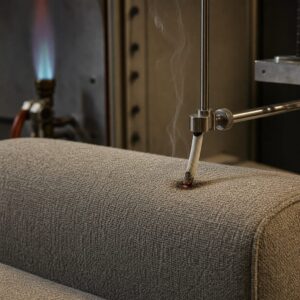
Somewhere in an accredited testing laboratory, before your sofa made it onto the shop floor, someone held a lit cigarette against its fabric and watched to see what happened. Then they did it again with a gas flame. Your sofa passed. That's why you were allowed to buy it.
This is not a niche industrial quirk. It's a legal requirement that quietly shapes the physical composition of almost every upholstered item in a British home – sofas, mattresses, cushion pads, divans, the lot. The Furniture and Furnishings (Fire) (Safety) Regulations 1988 are the reason your living room looks the way it does from the inside out, and most people who own a sofa have no idea they exist.
How do the Regulations Actually Work?
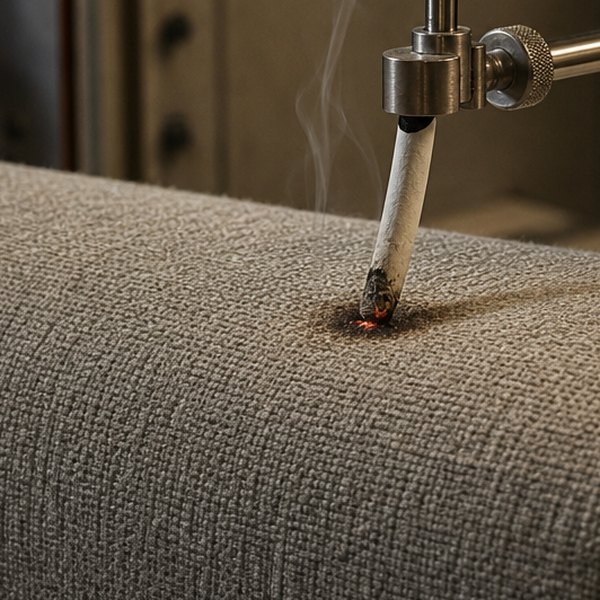
The testing itself is oddly specific. Filling materials – the foam, fibre or other stuffing inside the piece – are tested using a lit gas flame held against them for a set duration. The cover fabric gets a different treatment: a smouldering cigarette source laid on top and against it. There are also tests involving the composite effect: the fabric over the filling as a combined system, because sometimes materials behave differently when layered together than when tested alone.
If the furniture fails, it cannot legally be sold in the UK as new domestic furniture. Manufacturers and retailers both carry responsibility for compliance, and the regulations apply to anything with upholstered seating or sleeping surfaces intended for home use.
Why 1988? Because the Seventies Were Lethal
The rules did not emerge from nowhere. Throughout the 1960s and 1970s, polyurethane foam became the cheap, comfortable filling of choice for British furniture. It was everywhere. It was also, as people eventually had to reckon with, extraordinarily flammable – a cigarette dropped on an old foam-filled sofa could have the thing fully ablaze within minutes. Domestic fire deaths in the UK during this period were significantly driven by upholstered furniture, and post-mortem toxicology was frequently pointing not just at the burns but at the toxic gases the burning foam produced.
The 1988 regulations were the government's response. They effectively forced the industry to use materials that would resist ignition, or to treat existing materials so they would.
The Chemical Question Nobody Has Quite Resolved
Here is where the story gets genuinely uncomfortable. One of the most common ways to make foam and fabric pass a flame test is to add chemical flame retardants. And flame retardants – particularly the brominated and organophosphate varieties that became widespread in furniture – have spent the last two decades accumulating a fairly troubling body of scientific attention around their effects on human health and the environment.
They migrate out of foam over time, turn up in household dust, and have been detected in human blood samples.
The debate has been live for years. The regulations have been under review – repeatedly – precisely because of this tension: the original rules pushed manufacturers toward chemical solutions, and those solutions may carry their own risks. Some argue the fire safety justification for the regulations as written has weakened, because modern ignition scenarios and modern materials have both changed. Others point out that the alternative – less fire-resistant furniture – carries obvious and immediate danger.
For a thoughtful look at how people actually use and furnish their living spaces today – the rooms where all this furniture ends up doing several jobs at once – The Room That Had To Do Everything is worth a read.
What This Means When You're Shopping
Practically speaking, any new upholstered furniture sold by a reputable UK retailer will be compliant. The label sewn into the lining that says something like "Carelessness causes fire" and references the 1988 Regulations is the visible sign of this. If it's missing from a new piece, that's a problem.
The more interesting question is what's inside. Some manufacturers have moved toward naturally flame-resistant materials – wool, for instance, has inherent fire resistance and requires no chemical treatment to pass the tests. Others use treated foam. The regulations do not specify how you achieve compliance, only that you do.
So when you're choosing upholstered furniture, it's entirely reasonable to ask the retailer what the filling is and how the flame resistance is achieved. They should know. And now, so do you.
Questions this raises
- Why does UK furniture have fire safety labels?
- Are second-hand sofas covered by fire regulations?
- What does the fire label on a sofa mean?
- Do imported sofas meet British fire standards?