
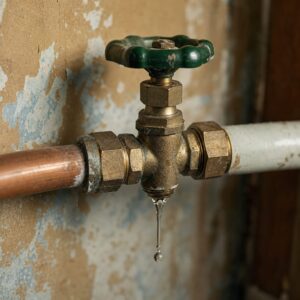
Somewhere in Britain right now, a homeowner is standing in front of a dripping stopcock wondering what they're actually supposed to do with it. They are not stupid. They have a job, a mortgage, possibly a very sophisticated opinion about coffee. They just never had to know this. And here is the quietly extraordinary thing: thirty years ago, they wouldn't have needed to.
In 1975, if you lived in a council house – which, in many parts of Britain, meant roughly a third of the population – the boiler was not your problem. The cylinder wasn't. The pipes weren't. They belonged to the local authority, and when something went wrong a man with a board of tools would appear, fix it, and disappear again without anyone learning anything. The gas board operated in roughly the same spirit. You turned things on. Other people kept them running.
The Transfer That Nobody Announced
The Right to Buy scheme, introduced in 1980, moved about 1.5 million council homes into private ownership in its first decade alone. Which was, depending on your politics, either a liberation or a slow-motion reorganisation of who absorbs risk. But here is the bit that never made the headlines: along with the keys and the deeds, buyers received the full mechanical responsibility for an ageing building that had previously been maintained by people with actual training.
The paperwork transferred. The knowledge didn't.
A generation of new homeowners became responsible for bleeding radiators, checking boiler pressure, insulating pipes before winter and draining them before going away, without anyone sitting them down first. Not because anyone was being careless. Just because it had never occurred to the people doing the handing over that they were handing over a syllabus.
What the Man With the Van Actually Knew
Here is what the man with the van understood that most homeowners still don't: a heating system is not a static thing. It corrodes from the inside. The water circulating through your radiators carries dissolved oxygen, and that oxygen slowly turns the inside of your radiators into a fine black rust sludge called magnetite. That sludge sinks to the bottom of the radiator, so the bottom goes cold while the top stays warm.
This is not a broken radiator. It is a radiator telling you something quite specific about its insides.
The man with the van would bleed it, power-flush it, or recommend inhibitor fluid. You, standing there with a bleeding key and a bowl to catch the drips, are doing exactly what he did. The only difference is that he'd been shown.
The same logic applies to boiler pressure (it should sit between 1 and 1.5 bar on the gauge when the system is cold), to the expansion vessel nobody mentions until it fails, and to the condensate pipe that freezes every February and convinces thousands of people their boiler has broken when it just needs a kettle of warm water poured over it. None of this is complicated. All of it is exactly the kind of thing that used to live in an engineer's head and now needs to live in yours.
The Gap Where the Knowledge Used to Be
The odd thing is not that people don't know it. The odd thing is that there was never a moment when someone was supposed to teach it. Estate agents do not explain seasonal maintenance. Solicitors do not include a chapter on what to do when your system makes a sound like a distant marching band. Surveyors will note a boiler's age but won't tell you that most boilers need the pressure topping up once a year and will lock out and flash an error code when they don't get it.
For the full list of things your house has been quietly trying to explain at inconvenient hours, visit What Your House Is Trying to Tell You at 3am at perkypad.co.uk.
What You Inherited
The 1970s tenant was not ignorant. They just had a different arrangement: the building worried about itself on their behalf. That arrangement ended, and now you worry about it, armed ideally with roughly the same institutional knowledge the building's previous custodians had built up over decades.
The pressure gauge. The bleeding key. The inhibitor. The frozen condensate pipe. The cold patch at the bottom of the radiator. These are not obscure technical problems. They are just the syllabus that got lost in the post when the deeds arrived.
FAQ
What should my boiler pressure be?
The boiler pressure should read around 1-1.5 bar on the gauge when the system is cold. Typically the pressure needs to be topped up about once a year; should the pressure drop below this, the boiler may lock out and display an error code which could be wrongly assumed to be a serious breakdown of the boiler.
Why is the bottom of my radiator cold when the top is warm?
A cold patch at the bottom of a radiator usually indicates the presence of rust sludge having built up within the radiator. This occurs due to corrosion of the radiator caused by dissolved oxygen in the water, and the sludge, known as magnetite, will settle to the bottom of the radiator. This can cause the bottom of the radiator to remain cold whilst the top remains warm. Typically this type of problem is treated by bleeding the radiator, power-flushing the system or by adding a system inhibitor to the water.
Why does my boiler stop working in February?
Many apparent boiler failures in February are actually down to frozen condensate pipes. The boiler is often assumed to have broken, but pouring warm water from a kettle down the frozen section of pipe is usually all that is required to put the problem right, a simple repair that used to be within an engineer’s knowledge.
How many council homes did Right to Buy move into private ownership?
Right to Buy, introduced in 1980, transferred the ownership of approximately 1.5 million council houses to new homeowners in the first decade of the policy. Although the new homeowners were responsible for the maintenance of older properties that local authority workers had previously looked after, they did not receive any of the practical knowledge required to maintain heating systems in these buildings. All the new homeowners received was the associated paperwork.