
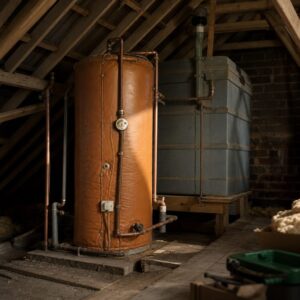
Somewhere in a loft above a 1960s semi, there is almost certainly an old copper cylinder sitting in the dark. It might have a lagging jacket around it, still orange or brown, that looks like a jacket potato someone forgot about. Next to it, or near it, there will be a cold water tank – a big plastic or galvanised steel box that used to feed the whole house. The people who live there now use a combi boiler on the kitchen wall and have no idea what any of this stuff was for. Which is a pity, because it was actually rather clever.
What a Direct System Was Doing
The old setup is called an open-vented or direct system, and for most of the twentieth century it was just "how central heating worked". The logic was straightforward. Cold water from the mains filled a tank in the loft by gravity, and that tank fed the hot water cylinder downstairs. The boiler heated water in a circuit that ran through the cylinder and round the radiators. The system was open to the atmosphere through a small pipe called the vent pipe, which stuck up over the tank and let any steam or expansion escape harmlessly. Nothing was sealed. Nothing was pressurised. If something went wrong, the water went somewhere obvious rather than building up pressure until something gave way.
Crucially, anyone with basic tools could work on it. The tank had a ballcock. The cylinder had an immersion heater. The radiators bled with a simple key. A competent plumber could drain the whole thing down in twenty minutes and refill it just as quickly, with parts that were standard and cheap. The system asked very little of you. You could keep it going almost indefinitely.
Why It Made Perfect Sense at the Time
Britain has famously soft water in some regions and aggressively hard water in others, and the open system had no particular quarrel with either. Because it wasn't sealed, you weren't trapping water inside a closed loop and then worrying about what it was doing to your pipes over years. Limescale was a problem in hard water areas, yes, but it was a manageable problem, not a chemical arms race. You didn't need inhibitor fluid. You didn't need a pressurisation unit or an expansion vessel. There was no pressure gauge to check, no magic pressure number to maintain (the sealed system wants to sit around 1 to 1.5 bar when cold, and it will tell you about it in passive-aggressive fashion if it drops). The open system just quietly got on with it.
There's a useful comparison in how pubs managed their hot water for decades – big, open, gravity-fed systems that a handyman could service without a manufacturer's manual. For more on that practical tradition, see What the Pub Landlord Knows That You Don't (https://perkypad.co.uk/maintenance/what-the-pub-landlord-knows-that-you-don-t/).
The Thing That Finished It Off
So why did it go? Not because it was badly designed. It went because it had a specific weakness that became catastrophic once tastes changed. An open system ran at low, gravity-fed pressure. That was fine for a bath with the taps dribbling away, but absolutely not fine for a power shower at mains pressure. By the late 1980s and through the 1990s, the mains-pressure shower became the thing people wanted. An open-vented system simply couldn't deliver it. You'd need a pump, and even then you were working against the fundamental logic of the setup.
Into this gap walked the combi boiler. It borrowed its core approach from commercial and industrial sealed heating – a closed loop of pressurised water, an expansion vessel to handle the extra volume when it heats up, everything contained and tidy. Crucially, it also took hot water directly from the mains, so the pressure in your shower was the same as the pressure in your street supply. The loft tank went. The cylinder went. The boiler did everything, in a box on the wall.
Once the market tipped toward combis, it tipped completely and very fast. Builders stopped installing open systems. Manufacturers concentrated on sealed-system components. Within a decade, the direct system went from standard to legacy to almost forgotten.
What Your Combi Boiler Is Actually Doing
The reason this history matters is that it makes your current boiler easier to understand. When your engineer talks about system pressure, or topping up via the filling loop, or why you can't just add water from a hose – that's all because you now live inside a sealed loop that was originally designed for a factory, adapted for a house, and stripped back to fit on a kitchen wall. It's brilliant engineering. It's just not quite as intuitive as a tank in the loft and a cylinder that you could see, touch, and understand at a glance.
That old copper cylinder in the dark wasn't a primitive thing someone hadn't got round to upgrading. It was the whole system, and it worked.
FAQ
What is an open-vented heating system?
This type of hot water system is known as an open-vented system, which is an older style direct hot water system, where a loft tank supplies a hot water cylinder by gravity, and the boiler supplies hot water to the cylinder and radiators. A vent pipe allows steam and expansion to escape from the system, and the system is open to atmosphere, ie non-sealed and non-pressurised.
Why did open-vented systems disappear?
The open-vented system type of older hot water system was generally run at a low pressure (gravity fed) which was satisfactory for supplying a dribbling type bath but not suitable for providing a mains-pressure power shower. When people wanted those showers in the late 1980s and 1990s, the combi boiler filled this gap by taking hot water straight from the mains, and builders and manufacturers then switched to sealed hot water systems within about a decade.
What pressure should a sealed heating system be at?
A sealed system would generally be expected to run at approximately 1-1.5 bar when cold. If the pressure drops then the boiler will indicate it. The system is topped up via the filling loop as opposed to filling via a hose. An open-vented system had no pressure gauge on it.
Why was an open-vented system easy to maintain?
The system ran with basic, standard, cheap components: a ballcock on the tank, an immersion heater in the cylinder, and simple bleed keys on the radiators. A competent plumber could empty and refill the system in about 20 minutes, without the need for inhibitor, pressurisation unit or expansion vessel.