
Before 1975, if you wanted to protect your savings against inflation, you had one strategy available to you: hope. Not hope dressed up in the language of finance, not hope with a graph attached – just plain, undisguised hope. You put money in a bank account, the bank gave you some interest back, and you crossed your fingers that the interest rate was higher than the rate at which everything in the shops was quietly getting more expensive. Sometimes it was. Often, through the 1960s and early 1970s, it spectacularly wasn't.
Inflation hit 25% in the UK in 1975. Your savings account was probably offering you something in the region of 7 or 8%. The gap between those two numbers was not a gap. It was a hole.
The Formula That Changed the Question
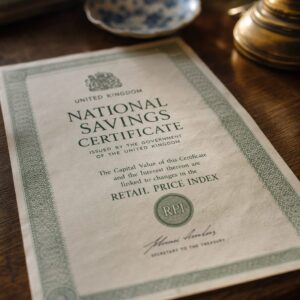
What the government did in 1975, when it launched National Savings Certificates tied to the Retail Price Index, sounds dry until you sit with it for a moment. Instead of setting an interest rate and hoping it kept pace with prices, they built a formula. The return on the savings certificate was mechanically chained to the RPI – so if inflation went up, the certificate went up with it. Automatically. No guessing. No hoping. No gap.
This is a stranger idea than it first sounds. Before it existed, saving money was fundamentally a bet – you were wagering that the number in your account would outrun a different number measured elsewhere. After it existed, the two numbers were the same number, by design. The question stopped being "will my savings keep up?" and became "they will keep up, by construction."
That shift – from judgment to mechanism, from bet to formula – is the thing worth thinking about.
Why Ordinary People Had Never Had This Before
Wealthy people had always had partial protection. Land, property, gold, equities: all things that tend to move roughly with prices over time, because they are real things in the world rather than promises written on paper. But you needed a fair amount of capital to get into any of those. You needed to know what you were doing. You needed to be able to afford to wait. The index-linked savings certificate was the first instrument that brought the formula itself – the mechanical link to an external price measure – within reach of someone who had £25 and a post office nearby.
For a piece on how this logic runs through the costs you don't always see coming, including the building maintenance bills that arrive without warning, The Bill That Handed You a Gutter and Wished You Luck.
The Logic That Quietly Took Over Everything
Here is the interesting part: the mechanism invented in 1975 is now so embedded in British financial life that most people interact with it constantly without registering it. Energy tariffs that rise with a specific index. Pension increases calculated against CPI. Student loan interest tied to RPI plus a percentage. Rental agreements with annual uplifts pegged to an inflation measure. Even some ISA promotional rates are structured against base rate movements in a way that echoes the same logic – automating the link rather than trusting human judgment to reprice it fairly.
You are not experiencing these as innovative. They feel like furniture. But they all descend from the same 1975 idea: that you could take the uncertainty out of a financial relationship by replacing a guess with a formula.
What "Saving" Actually Means Now
The word saving used to mean accumulating – piling up more of something. What the index-linked instrument quietly introduced was the idea that saving also means preserving – maintaining the real value of what you already have. Those are genuinely different jobs. Accumulation you can do by stuffing cash in a drawer. Preservation requires a mechanism, something external to measure against, and a link between the two.
Most people still talk about savings rates as if a higher number is always better, and it often is. But the more useful question – the one the 1975 invention was actually answering – is not "how much interest am I getting?" but "what is the gap between that number and inflation right now?" If your savings account is paying 4.5% and inflation is running at 3.5%, you are genuinely gaining ground. If it's the other way around, you are losing it slowly, and the number going up in your account is doing a polite little conjuring trick.
That trick is very old. The formula that catches it isn't.
FAQ
What was the 1975 index-linked savings certificate?
It was a National Savings Certificate (NSC) with its return linked to the Retail Price Index (RPI), launched by the government in 1975. The return would increase automatically with inflation, so there was no gap between return on savings and increase in prices, as would be the case with a conventional interest rate. Instead the return would increase in line with the RPI.
How much money did you need to buy an index-linked savings certificate?
Little. The first instrument to incorporate a mechanical link to an external price measure which could be accessed by someone with £25 and a local post office was the National Savings Certificate. The wealthy already had partial protection through land, property, gold and equities, but these required capital, knowledge and time to wait.
Where is inflation-linking used in British finance today?
For example, energy price increases can be linked to specific indices, rises in pensions will generally be linked to CPI rises, and the interest on student loans will be set at RPI plus a percentage. Similarly, annual increases in rent can be linked to inflation and some promotional rates on ISAs will move in line with base rate changes.
How do I know if my savings are really growing?
By comparing the interest rate on your savings with the current rate of inflation you get a better feel for whether you are winning or losing. For example, if your savings account is paying 4.5% and inflation is 3.5%, you are making gains. But if your savings account is paying 3.5% and inflation is running at 4.5%, you are suffering from erosion of your capital even though your bank balance is going up and up.