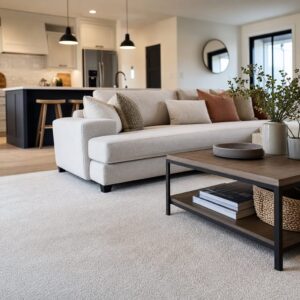
Somewhere in an office you will never visit, a person you will never meet has made a series of quiet judgements about your home. They have not seen your house. They have not knocked on your door. But they know you've gone open-plan, they suspect you have pale carpet, and they have Opinions about your kitchen island. They are an actuary, and your interior design choices have been feeding their spreadsheets for years without you ever signing a consent form.
This is not a conspiracy. It is just the quietly counterintuitive truth that every decorating decision you make is also, in some parallel universe of risk calculation, a statement about how you live – and what you are statistically likely to claim for.
The Carpet That Gives the Game Away
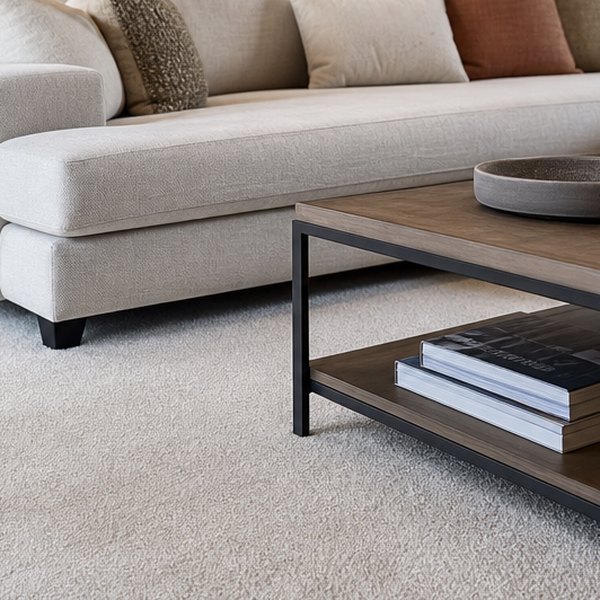
Start with something as innocent as flooring. Pale carpet – the kind of off-white, barely-there shade that interiors magazines have been pushing for the last decade – signals to insurers that you either have no children and no pets, or that you are optimistic to the point of recklessness. In practice, though, pale carpet correlates with a particular type of household: one likely to make a claim for staining or water damage, because the kind of person who installs pale carpet is also the kind of person who notices, and reports, when something goes wrong with it.
Insurers also read flooring as a flood indicator. Ground-floor fitted carpet in a flood-risk postcode is a significant contents liability – it cannot be lifted, it is expensive to replace, and it is usually ruined well before the homeowner has even noticed the water coming under the door. Hard flooring, paradoxically, signals lower risk. Things can be mopped. This is not to say you should rip out your rugs. It is just that your flooring has already voted in a risk election you did not know was happening.
What Open-Plan Kitchens Actually Cost
Open-plan living became the dominant aspiration of British interiors some time in the early 2000s and has not really loosened its grip since. Knock through, let the light in, run the kitchen into the living space, host like a Scandi architect. All of that is genuinely lovely. The fire risk implications, though, are less photogenic.
A kitchen inside a closed room with a door is a compartmentalised fire risk. Open-plan layouts are different – your kitchen flows directly into the sitting room and the dining area, which means fire and smoke travel faster through a property. That affects both buildings and contents premiums in ways that are rarely spelled out at the point of sale. The insurer isn't saying you can't have it. They are just quietly noting it in the policy, somewhere between the small print about unoccupied properties and the clause about subsidence.
For a different angle on what you actually own and control in your home, What You Buy When You Buy a House (It's Not What You Think) is worth a read.
The Wallpaper Problem Nobody Talks About
Here is an underappreciated headache. You have spent £120 a roll on hand-printed wallpaper – the sort that comes wrapped in tissue paper and smells faintly of a small family business in Yorkshire. It looks extraordinary. You have put it in the hall, the one room visitors see.
Now comes the hard part. Making a contents claim after a leak, or a fire, or some other category of domestic catastrophe means proving the value of that wallpaper – and that is genuinely difficult. Unlike a sofa or a television, wallpaper is partially structural once it is on the wall. Is it contents? Is it buildings? Whose excess applies? The honest answer is that most standard policies are vague on this, and vague policies tend to settle on the lower number payout. The more beautiful and specific your wall treatments, the more important it is to document them – photographs, receipts, the lot – because your insurer's mental image of "hall wallpaper" and yours are probably about £90 a roll apart.
The Actuary's Mental Picture of Your House
None of this means you should decorate for your insurance premium. That would be a miserable way to choose a colour scheme. But it is oddly freeing to know that your home is being quietly read by people who see patterns across millions of properties – and that what they see in your choices is not taste, or aspiration, but behaviour. The pale carpet is not an aesthetic preference to them. It is a data point. The open-plan kitchen is not a lifestyle upgrade. It is a fire compartmentalisation decision you made without realising it.
Your house has been making statements on your behalf all along. You just weren't copied in on the correspondence.
Questions this raises
- Does open-plan living raise your home insurance premium?
- How would an insurer know about a kitchen island?
- Should you tell your insurer about internal alterations?
- What home improvements make a claim more likely?