
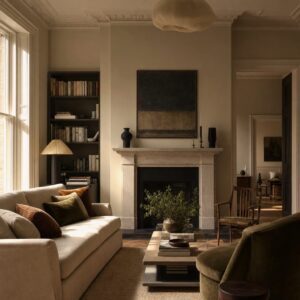
There is probably a room in your house that looks perfectly nice in photographs but is slightly odd when you are in the room. The sofa is fine, the rug is fine, that lamp you spent three weeks choosing is fine. But something is off, in a way you can't quite name and wouldn't know how to fix. You have been blaming yourself. You shouldn't be.
What you're bumping into is the ghost of a curriculum.
When Interior Design Had a Skeleton
Until the late 1980s Interior Design was taught as a technical discipline in the art schools and polytechnics of Britain. By technical I mean the way music theory is technical – there were rules and they had reasons for being there. Learning them made you better at breaking them.
Students worked through proportion theory – the idea, borrowed from classical architecture, that rooms have natural ratios that the human eye finds satisfying without knowing why. The height of a ceiling relative to the width of a room does something to the nervous system. So does a door placed at the wrong third of a wall rather than the right one. They studied sight lines – where your eye lands when you first walk into a space, and how furniture placement can guide or sabotage that instinct. They learned to read how light moves through a room across a day, which wall goes warm at 4pm in winter and which stays cold, and why painting them the same colour is a mistake even if they’re next to each other.
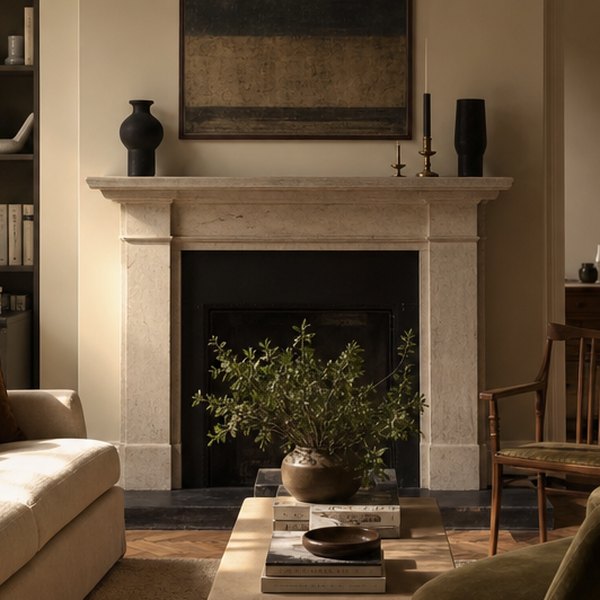
They also learned period styles not as a history lesson but as a structural one. Why a Georgian room works as a complete system. Why you can't just drop one Georgian element into an unrelated space and expect it to behave.
What the Reclassification Did
Interior design was quietly reclassified from a technical specialism to a ‘creative’ subject sometime in the late 1980s and into the 1990s. This shift, which sounds like a promotion but was really a loosening, took the bones out and substituted personal expression, mood boards, fabric samples and the language of ‘inspiration’. What left was the syllabus that explained why rooms work, rather than just what they could look like.
This wasn’t malicious but rather reflected a genuine cultural shift towards individualism and self-expression, and it probably made the courses more popular. But it also meant that a generation of practitioners — and through them, the broader culture — lost the shared technical vocabulary that lets you diagnose a room rather than just redecorate it.
The result is British interiors that are often individually plausible and spatially odd, tasteful and not quite coherent. They look great in a flat, overhead Instagram photograph, but in person they feel slightly airless. The furniture scale is wrong for the ceiling height, and the focal point lands behind the door, rather than opposite it. Every surface has been lit the same way, regardless of what time of day the room actually gets used.
The Knowledge That's Still There, If You Know Where to Look
This is a bit like the story over at The Beetle That Invented Your Mortgage – hidden structural logic that shapes how things work and which most people have no idea was ever there. The beetle shaped mortgage law without anyone noticing. A degraded training system shaped the way this nation decorates its homes and we blame ourselves for having bad taste.
These ideas still exist in the older design textbooks and so are still legible. There's a rule that a sofa should be roughly two thirds the length of the wall it faces. This is the same mathematical instinct that made Georgian rooms feel right. And there's the logic that you place your largest light source where it draws the eye on entry – not where the socket happens to be. This is the kind of thing a student would have been corrected on in 1975. Now you have to stumble across it alone.
The Question You're Actually Asking
When people say a room doesn't feel right, they're usually asking a technical question without realising it. They've been led to believe it's a question of taste, of confidence, of finding your style. Sometimes it is. But often it is a question of scale, sight lines, or the way afternoon light hits one wall and not the one next to it.
Your room isn't wrong because you chose badly, it's wrong because no one taught you the grammar.
Questions this raises
- What rules were taught on the old interior design courses?
- Why did British art schools drop the technical teaching?
- Can you still learn those design rules anywhere today?
- Does a room really need symmetry to feel settled?