
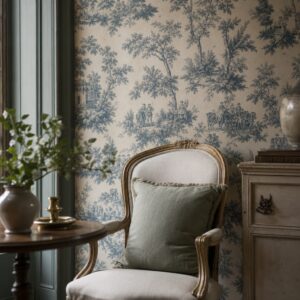
There is wallpaper somewhere in a Georgian townhouse. It’s behind three layers of Victorian paint and a sheet of 1970s woodchip. And if that townhouse is old enough then that wallpaper is, in some sense, French – not just inspired by France, not just reminiscent of France – actually, materially, philosophically French, right down to the hands that made it.
It’s strange when you are scrolling through a moodboard of “quintessentially British” interiors and realise that a lot of it arrived as refugee baggage.
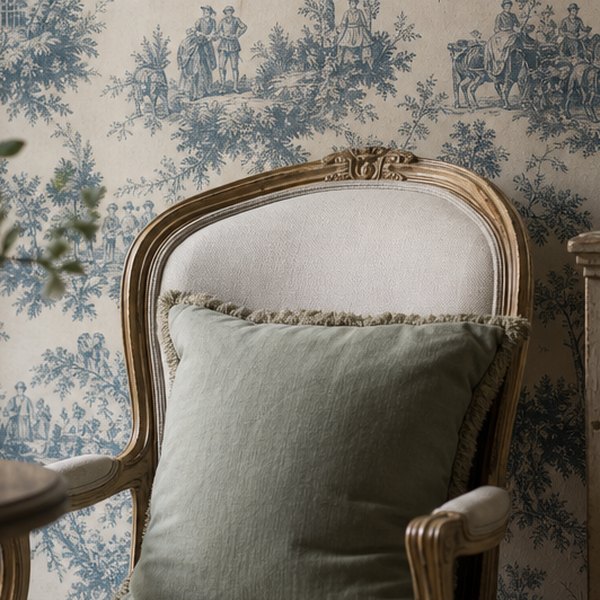
The Craft That Crossed the Channel
When in the early seventeenth century wallpaper was imported by wealthy British households, it came from France and was a luxury. The hand-painted, block-printed, extraordinarily detailed paper functioned less as a geographic label and more as a quality guarantee, the way “Swiss watch” still does. The craft was concentrated in France: the pigments, the techniques, the workers.
In 1685, Louis XIV revoked the Edict of Nantes, which had protected the right of French Protestants, known as the Huguenots, to practise their faith. In the years that followed, some 40,000 to 50,000 crossed into Britain, where many settled in Spitalfields in London, as well as in Canterbury and Norwich. They brought with them their skills as weavers, dyers, metalworkers and papermakers, but also the entire intellectual architecture of their trades – the patterns, the dye formulas, the block-cutting techniques, the sense of what a beautiful room was supposed to feel like.
Why "French Paper" Stayed French Even After the French Had Gone
Huguenot craftsmen, who had set up workshops in Spitalfields, made this wallpaper on British soil with British materials. Still, the ‘French paper’ label was what customers asked for and what merchants sold under that name – it had become a proxy for a standard of craft rather than an actual place of origin.
As with “Persian” rugs and “Brussels” lace, the geography became a quality signal long after production had dispersed elsewhere. But wallpaper was different: the very people who had made French paper French were now making it British, and still calling it French because that was what sold.
When these Huguenot craftsmen settled, the patterns they brought with them were not abandoned. They were adapted, layered and slowly absorbed into what became a recognisably British decorating sensibility. The Huguenot taste for symmetrical botanical repeats, for rich but controlled colour, for rooms that felt considered rather than accidental, became the backbone of what Georgian and later Victorian decorators treated as simply 'the done thing'.
What They Left Behind in the Pattern Books
For later British wallpaper designs visit How to create a WFH office without losing a bedroom.
The specific contribution of Huguenot craft to British wallpaper is sometimes hard to isolate precisely because it was so thoroughly absorbed. However, it is possible to trace a through-line from the block-printed papers of Spitalfields workshops in the 1690s to the William Morris designs of the 1870s, which Morris himself described as drawing on historical pattern traditions. The repeat structures, the preference for organic forms arranged with geometric discipline, the sense that a wall should hold your attention without shouting at you. These are Huguenot fingerprints pressed so firmly into British taste that they became invisible.
There is, in a way, the most complete kind of influence: a set of ideas that arrived with a group of frightened people on boats. Instead of an exotic import or a moment of fashion, these ideas got picked up by everyone else and eventually became so native that nobody noticed they had come from somewhere at all.
The Room That Remembers
So next time you see a wallpaper described as traditional British or classic English floral you might as well know what that actually means. It means the Huguenots made it to Britain, set up a workshop in cramped Spitalfields lodgings, and then got back to work. Every pattern repeat on the walls of Britain is, in some small way, a record of that crossing.
Questions this raises
- Where did British wallpaper designs originally come from?
- How was Georgian wallpaper actually made?
- Can you date old wallpaper found under paint?
- Is original Georgian wallpaper worth preserving?