
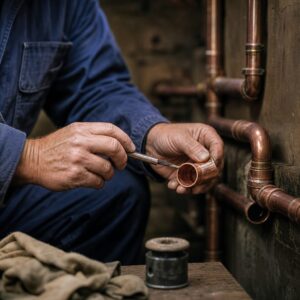
There is a pipe joint somewhere in the north of England – in a mill-turned-flat, probably, or a Victorian terrace that has survived four different owners and two botched renovations – that is still holding after seventy years because somebody once learned exactly how much heat to apply, at exactly what moment, before touching solder to copper. They learned it by watching. By being corrected. By doing it wrong twice and then feeling, in their hands, the difference when they did it right. That knowledge went into the joint. It also went nowhere else.
This is not a lament about the old days. It is just the strange truth about where plumbing knowledge actually lives.
The Tradition That Never Had a Textbook
The British plumbing apprenticeship, in its proper mid-twentieth century form, ran for five or six years. You did day-release at college, you worked through a graded series of practical benchmarks, and – most importantly – you spent years alongside someone who had done the same. The college gave you theory. Those years alongside gave you everything else.
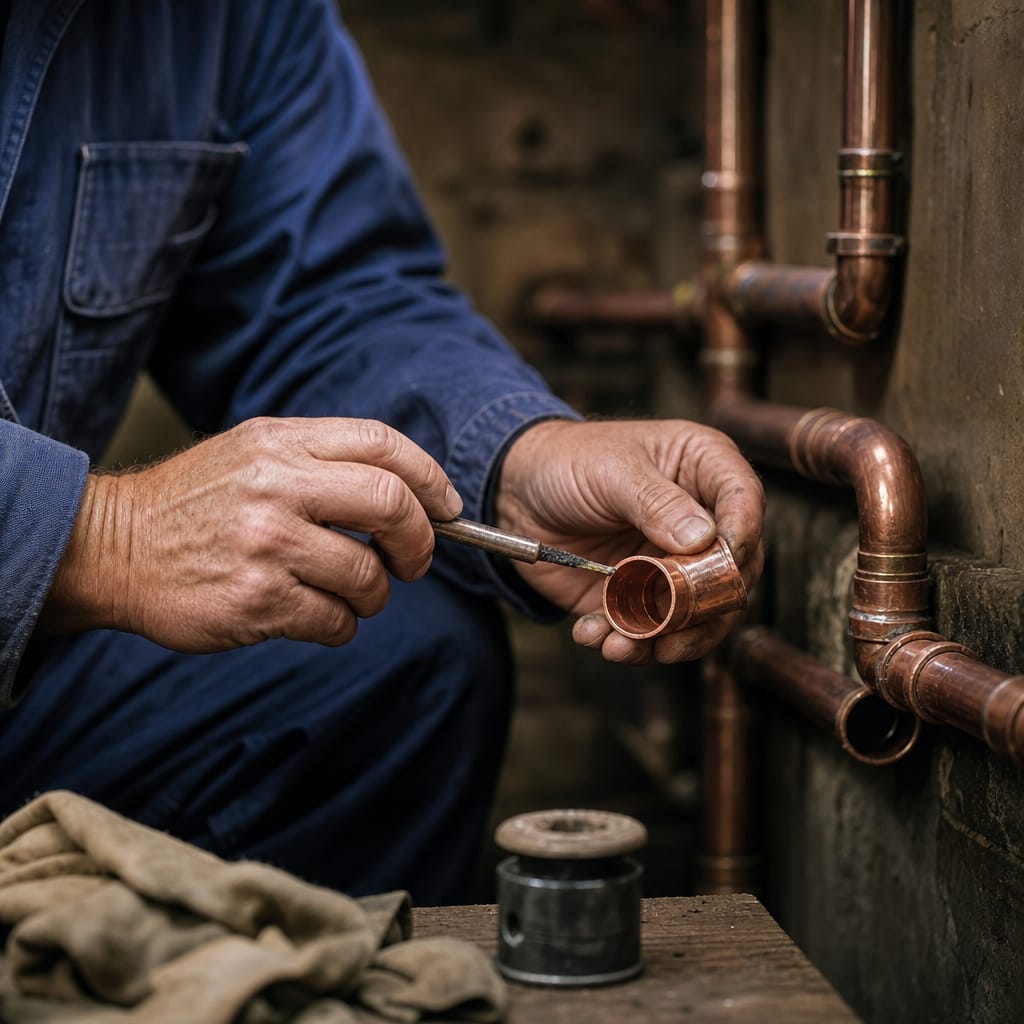
How a system sounds when it's circulating properly versus when it's fighting itself. How hard water in certain postcodes will kill a particular fitting within a decade. Why a flux-contaminated solder joint looks fine for three years and then doesn't.
None of that second category was written down. It was passed hand to hand, almost like a language spoken between tradesmen, region to region, building type to building type. A plumber trained in Glasgow learned the particular demands of tenement plumbing. One trained in Bristol learned something else. Both held City & Guilds certificates, and neither could fully translate what they knew into the other's situation without time on site.
What the 1980s Quietly Removed
Then apprenticeship numbers collapsed. This happened partly through policy – the apprenticeship system felt slow and expensive – and partly through the confident promise of fast-track NVQs, which could certify competence in a fraction of the time. What the NVQ framework couldn't easily certify was the physical and intuitive stuff: reading a system under pressure by ear, knowing when a pump is cavitating just from the pitch of the noise it makes, understanding that certain jointing methods behave completely differently in old lead-lined pipes versus modern plastic push-fits.
The last cohort who had learned those things properly retired, or died, or moved on. And the knowledge moved with them, not into any archive or manual, but simply out of the trade.
No YouTube tutorial has filled this gap, though not for want of trying. Video can show you the motion. It cannot give you the resistance in your hands, or the smell of a joint going wrong a second before it fails, or the accumulated understanding of what that particular noise means in that particular type of building. That is a craft language – learned by immersion, or not really learned at all.
The Regional Postcode
This is partly why maintenance in Britain speaks with such strong local accents – not just in dialect, but in depth. The erosion of the apprenticeship system didn't happen evenly. Some regions – parts of Yorkshire, pockets of the West Midlands – held onto a strong trade culture longer, and the knowledge persisted in those places because the people who held it stayed close to the next generation long enough to pass it on. Elsewhere the chain broke earlier, or more completely. For more on why maintenance knowledge varies so sharply by region, Maintenance Speaks With a Regional Accent.
The result is a map of competence that has nothing to do with certification. Two plumbers holding identical paperwork can arrive at an old system – cast iron pipes, original fittings, water chemistry that's been doing the same slow thing to the same metal for fifty years – and have completely different conversations with it.
The Knowledge Is Still in the Buildings
Here is the odd thing: the knowledge did not entirely vanish. Some of it is still legible, if you know where to look. It is in the joints that haven't leaked in forty years. It is in the way an old installer routed pipes around a cold corner rather than through it, a decision that made no sense on paper but made perfect sense to someone who knew how that street sits in a frost. It is in the particular sound a well-balanced system makes when it's left alone and given nothing to fight against.
The buildings remember, even when the trade has half-forgotten how to read them.
FAQ
Why has so much plumbing knowledge never been written down?
There is much that has been learned by doing, by working under the supervision of experienced plumbers and, in time, gaining knowledge of how systems sound, how local water affects particular fittings and how various joints behave. While the theory is taught in college, the practical knowledge is passed down from tradesman to apprentice. Little of this is written down in manuals or archives.
What happened to plumbing apprenticeships in the 1980s?
While policy has characterised the apprenticeship route as slow and expensive, the promise of fast-track NVQs that can confirm an individual’s competence quickly has led to the more traditional 5-6 year route of training apprentices losing ground, and apprenticeship numbers falling dramatically. However, many NVQs struggle to confirm intuitive skills such as reading a system by ear.
Can YouTube tutorials replace hands-on plumbing training?
No, not fully. Video may show the motion, but it cannot give a full sense of the resistance one feels in the hands, the smell of a joint about to fail, or what a particular sound means in a building of a certain type. Such knowledge of a craft is acquired by immersion, or hardly at all.
Is any of the old plumbing knowledge still visible today?
Yes. While a lot of craft knowledge can’t be read from a building, some of it is still written into the building itself. You can look at joints that have not leaked in 40 years, at pipes that have been routed around a cold corner rather than through it, at the sound of well-balanced systems that have been left to their own devices. Anyone who knows how to look can still learn from this.