
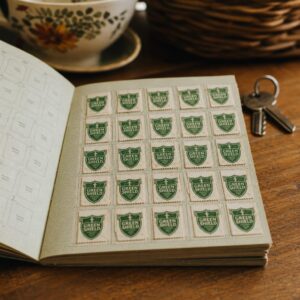
For a number of years in Britain, late 1950s to early 1980s, a significant chunk of the population had a second savings system, not kept in their building society but another way of saving. This did not pay any interest, nor was it tracked by a bank, but was a ‘savings system’ living in a little booklet in the kitchen drawer. It worked on stamps.
They weren’t postage stamps. Green Shield Stamps, Co-op dividend stamps, Pink Stamps, Embassy Stamps – and a dozen regional cousins besides. As people spent money at participating shops they would collect small sticky squares as proof and stick them into booklets. When enough booklets were filled they would be redeemed for goods from a catalogue – a kettle, a set of saucepans, a reclining chair. For millions of British households, these were not loyalty gimmicks to be half-noticed. It was a genuine, deliberate savings strategy. And for a while, it beat the bank.
Why Sticking Stamps in a Book Felt Better Than a Savings Account
It's hard to feel excited about a number in a passbook going up by small amounts. You know you're accumulating something, but you don't really feel it. In contrast, the stamps were visible progress. Every booklet of stamps was a tiny milestone. You could see you were three-quarters of the way there, and you had something in your hand that hadn't existed last month.
Behavioural economists would later spend decades writing papers about exactly this effect – the power of making progress concrete, of turning an invisible total into something you can hold. But Green Shield Stamps understood it by accident, or maybe by instinct, decades earlier. The half-filled booklet in the kitchen drawer was not only pulling you back to the shop. It was also genuinely keeping you motivated to save.
What You Actually Got for Your Stamps
The redemption catalogue itself was an event. At its peak, Green Shield's catalogue ran to hundreds of items, and flipping through it felt less like a voucher scheme and more like a department store you'd somehow earned access to. Toasters, electric blankets, cameras, cutlery sets, garden furniture. Ambitious households saved for years – stacking booklets in elastic bands, pooling stamps from relatives – aiming for something substantial. A piece of furniture. Curtains. Things for the home that would have taken months of cash discipline to afford outright.
This is where today's equivalent becomes interesting. The equivalent to these catalogue goods today would be bifold doors and considered living room furniture, which lasted a decade and changed how a room felt. If you're thinking about what to do with a living room now, 5 Living Room Ideas that Put Bifold Doors Front and Centre is a reasonable place to start even if funded differently.
Why the Whole System Collapsed
Green Shield Stamps did not die because British shoppers came to their senses. They died because of Tesco.
In 1977, Tesco dropped its stamps and cut prices instead. Asda followed. The competitive logic was simple and brutal: the cost of running a stamp scheme had to come from somewhere, and where it came from was prices. Once one supermarket had shown that cutting out the stamps and reducing prices was the way to win customers, the rest had to follow or lose ground. What had looked like a free bonus was in truth a slice of the margin given back to you in a roundabout way. And once that became obvious, the roundabout way looked a lot less appealing.
Inflation made it worse. The goods in the redemption catalogue kept getting more expensive. The purchasing power of a full booklet quietly shrank. By the early 1980s, the maths simply didn't hold.
The Thing Stamps Understood That We've Quietly Forgotten
Cash saving won. It was more flexible, more portable and eventually better value. Although this is all true, what’s left for most people is the most abstract, invisible and least motivating version of saving.
The stamp system knew that humans are not reliably rational about money. It knew that “you’ve nearly got enough booklets for the coffee table” is a more powerful sentence than “you’ve saved £47.80”. The system built the feeling of progress into the act of saving itself, week by week, sticky square by sticky square.
That's not a small thing to have lost. It's just a very small thing to have lost it to.
FAQ
What were Green Shield Stamps?
Green Shield Stamps were small sticky squares given out by participating shops for proof of spend. They were stuck into booklets and when full could be exchanged for goods from a catalogue for that spend. Co-op dividend stamps, Pink Stamps and Embassy Stamps were versions of these schemes, which ran from the late 1950s to the early 1980s.
Why did Green Shield Stamps end?
In 1977 Tesco abandoned its own stamps in favour of a cut-price strategy, with Asda following soon after. The cost of running a stamps scheme had to come out of retail prices, so rivals had to match or lose customers. As inflation escalated the cost of goods listed in the catalogues rose, so that by the early 1980s the arithmetic no longer added up.
What could you get with Green Shield Stamps?
Customers could exchange their stamps for things like toasters, electric blankets, cameras, cutlery sets and garden furniture. When Green Shield was at its most popular, catalogues contained hundreds of different items available for exchange using the saved stamps of customers. Items such as furniture and even curtains could be purchased by households with ambition, who would save for years to buy them.
Why did people prefer stamps to a savings account?
In addition to enabling customers to see how their savings were slowly increasing by reference to their passbook, the filled booklets of stamps provided visible proof of progress towards savings goals. This, in itself, motivated customers to continue to save and also generated repeat business in the shop.