
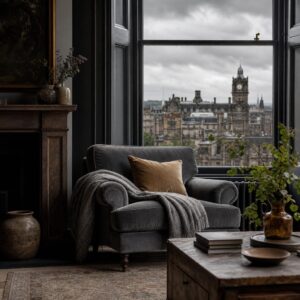
Stand in a British living room – almost any British living room – and you will notice roughly the same things. A pale wall. Warm undertones, creamy or slightly yellow, never quite white. The sofa angled hard towards the window. Maybe a mirror opposite it, bouncing what light there is back into the room like a hostage negotiation. This is not taste. This is survival.
Britain gets around 1,500 hours of sunshine a year. Southern Spain gets over 2,700. That gap – more than a thousand hours of light we simply do not receive – has quietly shaped every decorating convention we have inherited and then cheerfully repeated without asking why.
The Default Palette Is Not About Preference
Ask any interior designer why warm, creamy whites became the British decorating standard and they will probably say something about them feeling "cosy" or "timeless". Both true. But that's not the real reason.
Under a grey, diffused sky, cool white paint does something brutal. It picks up the ambient blue-grey of outdoor light and throws it back at you, making a room feel damp and slightly clinical – like a car park stairwell that someone has tried to humanise. Warm undertones counteract that. The creams, the off-whites with a breath of yellow or pink in them – they absorb what little warmth is available and amplify it. British decorators did not choose warm whites because they are charming. They chose them because the alternative looked like winter at all times.
The same logic runs through the national love of warm-toned wood floors, amber lampshades and terracotta accents. Every one of them is quietly compensating for something the sky is not providing.
One Window, and Everything Faces It
In sunnier countries, rooms are designed around shade – deep overhangs, shuttered windows, thick walls that keep heat out. British architecture did the opposite. The single large sash window, placed centrally on one wall and framed to let in maximum light, became the template for the ordinary British room. So everything in the room got arranged to face it.
This is why the British sitting room so often feels slightly like a theatre, with one wall doing all the work and the furniture set up to receive it. Not a stylistic choice so much as an inherited adaptation – generations of households orienting themselves around whatever light they could actually get.
When you are thinking about what a house's orientation really means – not just "will the garden get afternoon sun?" but the whole accumulated logic baked into which room sits where and why – it is worth reading What You Actually Buy When You Buy a House, which makes the point that buyers are often bidding on things they cannot easily name or see.
The Feature Wall's Unlikely Secret
The feature wall – one bold, dark or richly coloured wall in an otherwise pale room – peaked hard in the early 2000s and most people put it down to a certain decorating TV presenter and a tin of aubergine paint. Which is not wrong. But there is a more interesting reason it happened when it did.
The 2000s were when halogen lighting went mainstream in ordinary British homes, followed not long after by LED. For the first time, people had controllable artificial light bright enough to genuinely illuminate a whole room. Not just push the dark back a bit – which is what a floor lamp and a couple of table lamps do – but flood a space with something approaching daylight intensity. Suddenly a dark wall did not eat the room. It could hold its own against the light because there was finally enough light to hold against.
The feature wall was not a trend. It was the moment British interiors stopped being entirely at the mercy of the northern sky.
What the Sky Has Been Telling Decorators All Along
None of this means you should repaint everything immediately or feel that your choices are not your own. It is more interesting than that. When you pick a warm white, you are doing what people in these islands have done for a very long time – working with what the light gives you and making the best room you can out of it. The conventions feel like taste because they have been absorbed so completely. Underneath, they are just very sensible answers to a very grey sky.
FAQ
Why are British homes decorated in warm, creamy whites?
Warm toned whites counteract the cold, blue-grey light of a British sky, while cool toned whites absorb the ambient outdoor light and make a space feel damp and clinical. But in a country that gets only around 1,500 hours of sunshine a year, one way to add warmth to a space is with cream or off-white paints that contain yellow or pink to amplify the little warmth they do absorb. This is why they became the standard.
How much sunshine does Britain get compared with Spain?
Britain gets around 1,500 hours of sunshine a year; in southern Spain, the equivalent figure is over 2,700 hours. This gap of more than a thousand hours has, in part, led to many domestic decorating conventions which we currently adhere to, such as painting interior walls in pale warm colours and placing mirrors in order to get the most out of available daylight. The ways in which we arrange furniture in a room to maximise available light have also been affected.
Why is furniture in British living rooms arranged around the window?
British rooms originally centred round a large single sash window. It was positioned centrally on one wall to let in maximum light, and the furniture was then arranged to face it. A slightly theatre-like space was created, inherited from previous generations who found ways to orientate their furniture to best utilise the light available.
Why did feature walls become popular in the early 2000s?
Feature walls had their peak around the early 2000s, partly because halogen lighting reached mainstream status in British homes, followed by the advent of LED lighting. For the first time, homeowners had powerful, controllable artificial light sources that could fill a room. This meant a dark feature wall no longer dominated a space; it could hold its own against the new light.