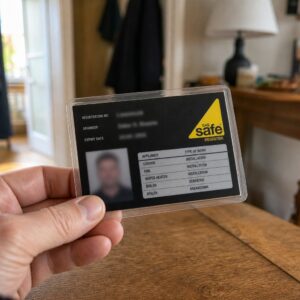
The engineer arrives, does a little half-bow, and presents you with a small card. You check there's a photo on it, confirm it hasn't expired, maybe clock the Gas Safe logo, and hand it back. Job done. Except you've just speed-read the most information-dense document that will come through your front door all year, and you've taken in roughly none of it.
That card is not just a licence. It's a taxonomy – a precise, coded breakdown of exactly which gas appliances the person standing in your hallway is legally allowed to touch, and just as usefully, which ones they aren't. Two engineers can both hand you an identical-looking Gas Safe card while being authorised to do entirely different things inside your home.
The Code System That Nobody Explains
On the back of every Gas Safe Register card is a list of codes. Letters and numbers, usually a handful of them, occasionally more. Each one represents a specific category of appliance and a specific type of work. These aren't ranked by skill level the way most people assume – like some kind of gas-fitting league table – they're categorised by appliance type. An engineer with a long list of codes isn't necessarily more experienced than one with three. They might just work on a wider variety of kit.
The categories include things like central heating and hot water boilers (the bread and butter of most domestic visits), cookers and hobs, gas fires, warm air heaters, and – this is where it gets genuinely interesting – specific categories for commercial catering equipment, LPG appliances, and even mobile homes and leisure vehicles. Yes, your static caravan in Pembrokeshire requires its own entirely separate certification. The engineer who fitted your combi boiler to perfection may be completely unauthorised to touch the gas supply on your narrowboat.
What the Letters Are Actually Saying
The codes follow a logical structure once someone bothers to decode it for you. CCN1, for example, covers central heating and hot water systems – it's the one you're most likely to see on a card pulled out for a boiler service or a new radiator. CKR1 takes you into cooker territory. HTR1 handles gas fires and wall heaters. LPG covers appliances running on liquid petroleum gas rather than the mains natural gas supply, relevant in rural properties where mains gas simply doesn't reach.
There are codes for meters and controls, for gas supplies themselves, for ducted warm air systems most people have never heard of, and for boiler flues checked as a standalone job. The card is structured so that you could, in theory, look up every code and arrive at a precise job description. Most people never do this. Which is why it stays laminated and largely mysterious.
For something completely different while you're thinking about what goes into your home, 5 Living Room Ideas that Put Bifold Doors Front and Centre has some genuinely practical ideas at https://perkypad.co.uk/interior-design/5-living-room-ideas-that-put-bifold-doors-front-and-centre-3/
The Appliance Nobody Remembers to Check
Here's the category that catches people out most often: gas fires. A huge number of domestic gas engineers are certified for boilers but don't hold the specific code that covers gas fire servicing and installation. So when your living room fire starts making a sound you don't like and your regular boiler engineer is available, check their card before they start rather than after. This isn't a gotcha. It's just how the system was designed – appliances that behave differently carry different certification requirements. A gas fire pulls combustion air from the room itself, which creates different risks from a flued boiler, so the training and testing are separate.
Why the Card Is Worth a Proper Look
The Gas Safe Register exists because gas kills when it goes wrong, and it goes wrong in very specific ways depending on the appliance. The categorisation system reflects that: it's built around the actual mechanics of how different appliances work and fail, not around some general sense of how good an engineer seems. Which means a two-second glance at a card doesn't really tell you anything useful. Thirty seconds on the Gas Safe Register's website – where you can type in a card number and see the full list of codes against a name – tells you exactly who you've got in your kitchen and what they're there to do.
The laminated card does all that. It's just never bothered to introduce itself properly.
FAQ
What do the codes on a Gas Safe card mean?
The codes are categories of appliance that the engineer is authorised to work on. They do not indicate a skill level. CCN1 = central heating & hot water, CKR1 = cookers, HTR1 = gas fires & wall heaters, LPG = liquid petroleum gas appliances. The longer list means more types of appliance.
Can my boiler engineer service my gas fire?
Not necessarily. The number of codes that a domestic engineer is certified for can vary. Often people are boiler service engineers and have no code for the servicing and installation of gas fires. This is because gas fires draw combustion air from the room and therefore are a different risk to that of a flued boiler, so training and testing are separate. It is wise to check the engineer’s card before they start work on a job rather than after.
How can I check what a Gas Safe engineer is allowed to do?
To find out which services a Gas Safe registered engineer can carry out, you can use the Gas Safe Register website and search for the card number. Within about thirty seconds you will be provided with a full list of the codes held against the engineer’s name, showing the exact appliances that they are authorised to work on.
Does a Gas Safe engineer with more codes have more experience?
No. The codes are grouped by appliance type not skill. So, an engineer with a long list of codes may work on many different types of equipment whereas another with only 3 codes may work on just 3 different types of appliances. Typical examples of such additional appliance types are: commercial catering equipment, LPG appliances, mobile homes and leisure vehicles, which each need separate certification.