
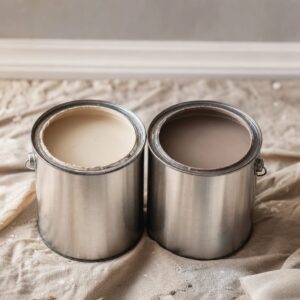
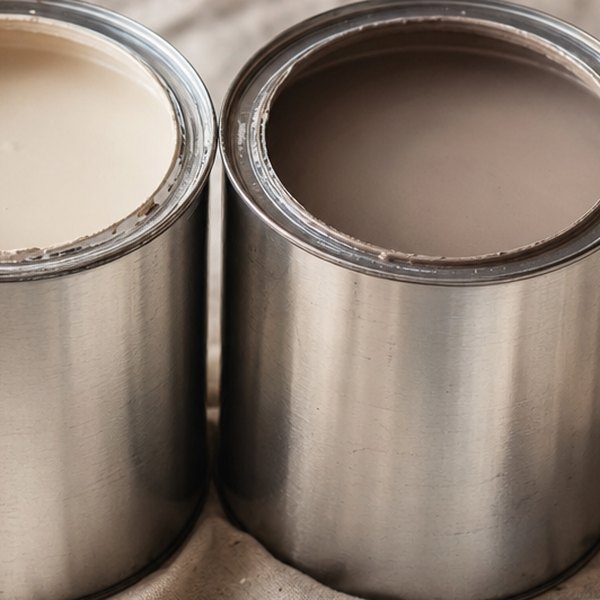
Buy a tin of Farrow & Ball's Elephant's Breath (yes, that's a real name, no we're not getting into it), use half of it, store it in the garage for eight months, open a fresh tin when you need to touch up a patch, and there's a decent chance the new paint won't quite match. Same brand, same name, same little number on the lid. And yet something will be off. Not dramatically off – nobody will point at your wall – but it will nag at you. The particular way that only decorating mistakes do. At 7am with a cup of tea.
You'll blame yourself. Wrong lighting when you chose it, maybe, or you applied it too thin. But the real culprit is a number you've never been told exists. One that paint manufacturers set quietly in their factories, deciding how different two tins of the same colour are allowed to be before anyone considers it a problem.
The Colour You Bought Is Not a Fixed Thing
Here is the part the paint industry doesn't put on the label: a named paint colour is not a single, precise colour. It's a range. In the factory, every batch gets measured by a machine called a spectrophotometer, which bounces light off a dried sample and records the result as a point in a three-dimensional colour space. The engineers then compare that point against the target – the idealised version of the colour – and calculate how far apart they are. That distance is expressed as a number called Delta E, written ΔE.
A ΔE of 0 means perfect, identical reproduction. A ΔE of 1 is the point at which the human eye, under laboratory conditions with the colours placed directly alongside each other, can just barely detect a difference. A ΔE of 2 is comfortably visible if you're comparing swatches side by side. A ΔE of 3 or above is the kind of thing that makes a trained colour matcher wince.
The industry standard for "acceptable" batch-to-batch variation for most interior paint? Somewhere between ΔE 1 and ΔE 3, depending on the manufacturer and the specific colour. Premium brands typically hold tighter tolerances than mid-range ones. Some difficult colours – deep reds, complex greys, anything with a lot of pigment variables – are given more leeway because they're harder to reproduce consistently. None of this appears on the tin.
Why Grey Is the Worst Offender
Certain colours are much harder to reproduce within a tight tolerance than others. A rich, warm red or a strong navy has so much pigment doing the work that small variations get masked. But a complex grey – the kind that reads as warm in the afternoon and cool in the morning, which is precisely why everyone's been buying them for a decade – is built from several pigments balanced against each other. Shift any one of them even slightly and the whole character changes. It might drift a little pink. Or a little green. Not enough to look wrong in isolation, just enough to look wrong next to itself.
This is why touching up a repainted wall almost never works. You're not covering a patch, you're adding a slightly different layer of the same story. The wall knows.
What This Means When You're Planning a Whole Room
If you're decorating a whole room in one go, with everything bought at the same time, most of this doesn't matter – the batch variation doesn't exist if it's all the same batch. The problem arrives the moment a project gets split across time, or across walls, or when a renovation isn't done all in one go. For ideas on planning a living room renovation properly from the start – walls, light, scale and all – there are some genuinely useful approaches at 5 Living Room Ideas that Put Bifold Doors Front and Centre, which looks at how larger design decisions interact with space and natural light in exactly the rooms where colour consistency matters most.
The practical upshot is simple: if you know a room will need more paint later, buy more now. From the same batch, which means from the same delivery, ideally on the same day. The batch number is printed on the lid. Two tins bought a week apart can have different batch numbers and ΔE values that are technically within tolerance and visibly not quite right.
Your walls aren't wrong. They're just made of maths.
Questions this raises
- Where is the batch number printed on a paint tin?
- How long can you store opened paint in a garage?
- Can you box two tins together to avoid a mismatch?
- Why won't a touch-up patch blend into the old paint?